
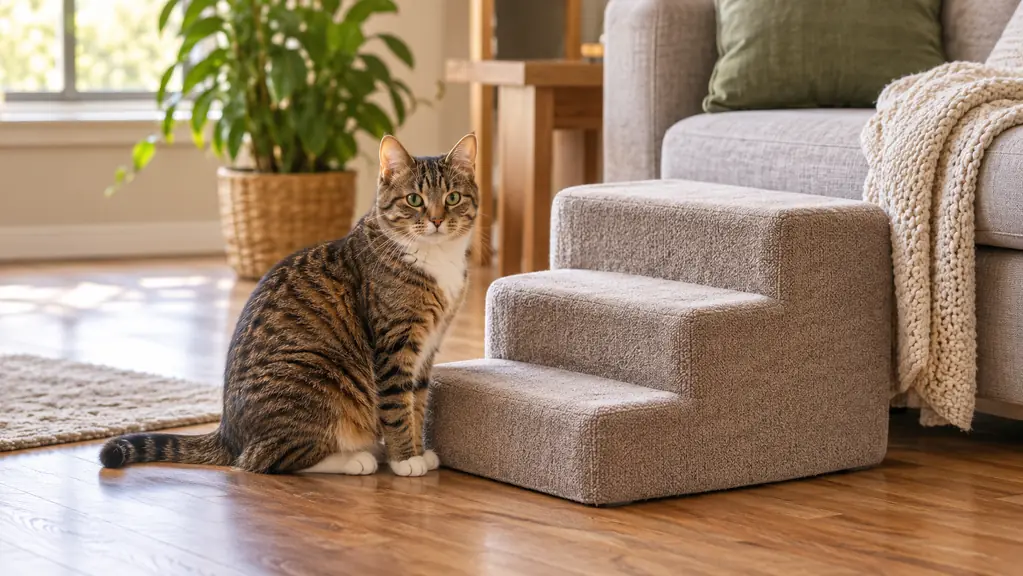
Biscuit is 14 years old, about eleven pounds, and was diagnosed with mild arthritis in his hips and back legs. The first sign was not a limp. It was a pause. He would stand at the side of the sofa, look up at the cushion, look back at me, and then lie down on the floor instead. When a cat stops going where he used to go, the furniture quietly turns into an obstacle course, and the cat shrinks his own world to stay comfortable.
So I did what I used to do at the clinic when an owner asked whether stairs or a ramp was better. I put both in front of him. A neighbor lent me a long cat ramp, the kind with raised side rails that leans against a bed or a sofa. I bought the aodisman pet stairs, the three-step foam model, and set them against the same sofa. Three weeks, one stiff cat, two options, and a lot of note taking on the back of an old appointment book.
The short answer, if you are deciding right now: the aodisman stairs are the better pick for a cat who has given up the sofa or his favorite chair. Three short steps break a 15.7 inch climb into pieces a sore cat can take one at a time, and the treads are 15.7 inches wide, so he has somewhere to put all four paws. A cat ramp wins when the target is high, and it wins on storage and on setup day. For Biscuit, the stairs got used every evening by the second week. The ramp got used only when I propped it against the bed.
| aodisman Pet Stairs | A Cat Ramp | |
|---|---|---|
| Height it reaches | 15.7 inches at the top step, which is sofa and chair height | Longer ramps reach tall beds, high perches and counters |
| How the cat climbs | Three separate steps spread across the 15.7 inch rise, so he can stop flat and rest | One continuous incline, so a stop means standing on a slope |
| Landing width | 15.7 inches wide, all four paws land on the same step | Narrower deck, so front paws on with back paws trailing is common |
| Footprint | 22.4 inches deep and it does not fold, so it lives in front of the sofa | Longer on the floor, but most models fold flat for storage |
| Setup | Foam, needs 48 to 72 hours to fully expand after unpacking | Unfolds and leans, usable the same day |
| Surface | Corduroy fabric cover on the steps for claw grip | Carpet or grip tape on a narrower deck |
| Moving it | 4.3 pounds, slides out of the way with a foot | Varies by frame, folding models are usually bulkier to carry |
| Cleaning | Fabric cover collects hair and needs regular vacuuming | Hard surfaces wipe clean |
| Weight limit | 60 pound maximum listed, with a recommendation for pets under 50 pounds | Varies by model and by how the frame is built |
| Warranty | 6 months | Varies, and soft goods often carry none |
Where aodisman Pet Stairs Win
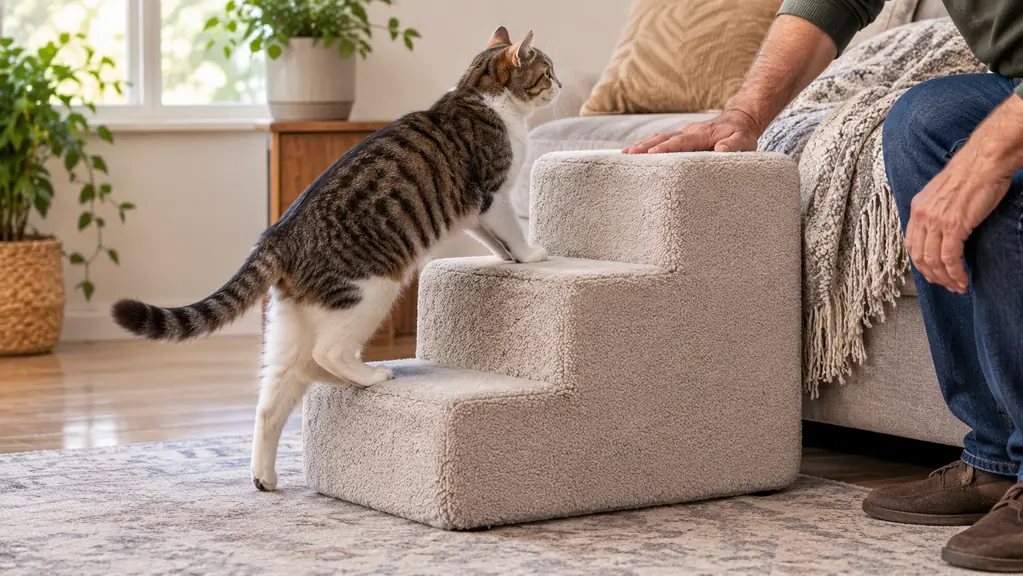
The case for the steps is simple, and it is the reason I reach for them first with hip arthritis. A ramp is one continuous climb. A cat with sore hips has to commit to the whole slope, and if he stops halfway he is standing on an incline, which is the exact position that hurts most. Three separate steps let him stop flat. Up one, rest, up two. That rest is not a small thing. I have watched a great many senior cats take a staircase one tread at a time and then lie down at the top, and that is precisely the pattern that keeps them moving.
The second thing the aodisman stairs get right is the landing width. At 15.7 inches across, a cat puts all four feet on the same tread instead of hooking his front paws over the edge and hauling the back half up behind him. On the ramp, Biscuit consistently planted both front paws, left his back paws on the floor for a beat, and then pushed off. That push is the motion that loads the hips. On the steps he simply stepped up, and there was nothing to push off from.
At 4.3 pounds it also moves when you want it to and stays put when you do not. I nudged it out of the walking path with the side of my foot every morning and put it back against the sofa every evening. The corduroy cover matters more than it sounds. Cats grip with their claws, and fabric gives them something to catch, which is why Biscuit trusted the second step well before he trusted the top one.
Where a Cat Ramp Wins
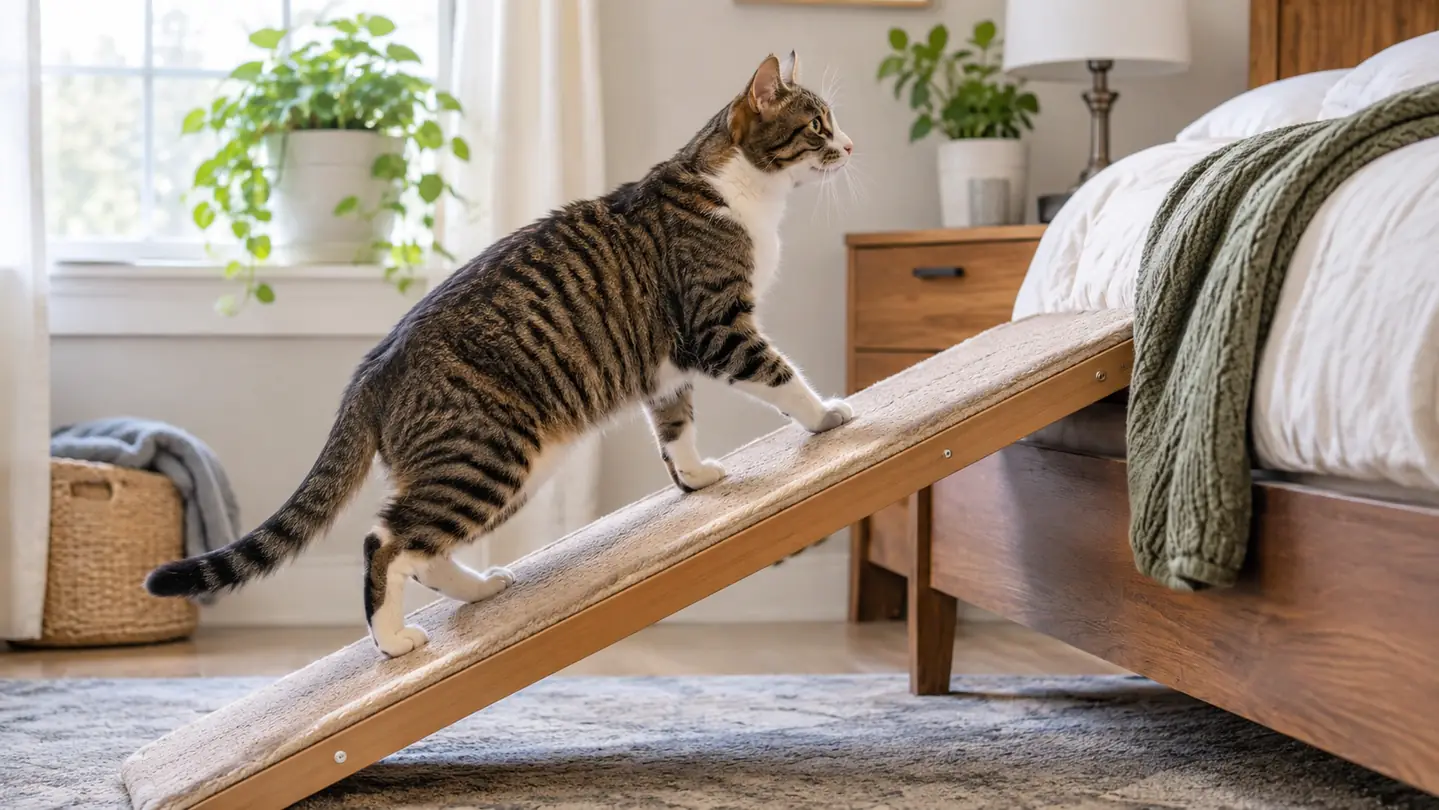
The ramp's advantage is length, and it is not a small one. A longer run means a shallower angle, and a shallow angle is easier on shoulders and hips than a short steep climb. The aodisman stairs top out at 15.7 inches, which is sofa and chair height. If your cat's spot is a bed sitting at 24 or 25 inches, or a windowsill above the sofa back, the three-step model will not reach, and the listing says so plainly. Three steps for sofas and chairs, four and five steps for beds and high beds. That is an honest piece of sizing advice, and it is also the clearest reason to go with a ramp or buy the taller version.
The ramp also folds. The one I borrowed went flat and slid behind the bedroom door when it was not in use, which matters in a small house. It was usable the minute it came through the door, while the aodisman foam needs 48 to 72 hours to fully expand after you unpack it, so on day one you are watching a compressed block slowly become a staircase. And a hard-surfaced or carpeted ramp wipes clean in a way a fabric cover never will. If you have a cat who sheds heavily or gets carsick, that is worth something.
The last point, and the one people forget, is that a ramp has no lip. There is no edge to step over at the bottom, just a surface that meets the floor. Some cats are unsettled by an open ramp with no sides to brace against, and some are unsettled by the open edge of a step. That part you cannot predict from a spec sheet. You find out by putting both down and watching for a week.
If the sofa is the spot your cat has quit, start with the three-step model
15.7 inches high, 15.7 inches wide, 4.3 pounds of foam with a corduroy cover on the treads. It fits a sofa or a chair, and it lets a sore cat stop and rest between steps instead of committing to one long slope.
Amazon Check Availability on Amazon →What a Stiff Cat Actually Needs
After 22 years in a small-animal clinic, the thing I still say most often to cat owners is that cats do not show pain the way we expect. They do not cry or favor a leg dramatically. They stop doing things. They stop jumping to the windowsill. They hesitate at the edge of the bed. They sleep more, they get crankier about being picked up, and sometimes they start missing the litter box because the wall of the box has become a hurdle. By the time an owner notices a limp, the cat has usually been managing for months.
So the first step, before you buy anything, is a vet visit. Arthritis is diagnosed by touch and by watching the cat move, and there are other things that look like stiffness, from dental pain to nerve problems. Biscuit's diagnosis came from our vet, along with a weight target and a plan. What I am describing here is management, not treatment. A set of stairs does not do anything for a joint. It removes one specific daily struggle so the cat keeps using the furniture and keeps moving, and movement is what keeps a stiff cat from getting stiffer.
Two other things are worth more than any product in this comparison. Keep the cat lean, because every extra pound is load on sore hips. And look hard at the litter box, the food bowl and the water bowl. A box with high sides is a wall to a cat who cannot raise his back leg, and a bowl on the floor is a crouch. Raising the bowls an inch or two and switching to a low-entry box costs almost nothing and removes two daily obstacles before you ever get to the question of stairs.
The measure of whether it worked was not that he climbed faster. It was that he stopped walking away from the sofa.
The Details That Decide It
The single most common complaint about this kind of foam stair is that it arrived flat. It is compressed for shipping, and the listing is upfront that it needs 48 to 72 hours to fully pop up and unfold into the shape of a staircase. Do not let a wobbly senior cat near it during that window. Give it the full three days in a warm room, and put it in place only when the steps feel firm under your hand. A cat who tries a half-expanded stair and feels it shift may refuse it for good.
Sizing is where most people get this wrong, and the listing actually spells it out. Three steps for sofas and chairs. Four steps for sofas and beds. Five steps for beds and high beds. Measure the height of the surface your cat is avoiding before you order anything. If it comes out at 15 or 16 inches, the three-step model matches it. If it comes out higher, order up, or accept that a ramp is the better shape for the job. The weight figures are worth reading closely too. The maximum listed is 60 pounds, and the listing itself recommends it for pets under 50 pounds, which is sensible. Foam that is rated to a limit will still soften over time at the top of that limit, and a soft step is worse than no step.
Two smaller things I noticed over three weeks. The corduroy cover collects orange cat hair the way a sweater collects lint, so plan on a vacuum pass every couple of days. And the warranty runs 6 months, which is short but not unusual for a foam product. If a seam lets go in month two, you want to know that number now rather than later. None of that changed my mind about the shape of the thing. It just told me what I was actually buying.
What I Liked
- Three separate steps let a stiff cat stop and rest flat between each one
- 15.7 inches wide, so all four paws land on the same tread
- Corduroy cover gives claws something to grip
- 4.3 pounds and easy to slide out of the walking path
- Reaches sofa and chair height at 15.7 inches, which is where most senior cats give up first
Where It Falls Short
- Needs 48 to 72 hours to fully expand after unpacking
- Does not fold, so it occupies 22.4 inches of floor in front of the sofa
- Fabric cover holds hair and needs regular vacuuming
- Top step is not high enough for a tall bed, you would need the four or five step version
- 6 month warranty is short
Who Should Buy Which
Buy the aodisman pet stairs if your cat has quit a sofa, a chair, or a low bench, and if the thing you notice is hesitation rather than a refusal to move at all. Buy them if your cat tends to stop halfway up things, because a flat tread to rest on is the whole point. Buy them if you want something you can slide out of the way with a foot and put back in the evening, and if the surface being reached is roughly sofa height. For Biscuit, that was the whole job, and the stairs did it. He takes them in one steady climb now, most evenings, without the pause.
Buy a cat ramp instead if the target is a tall bed, a high perch, or a counter, and if you want a shallow angle over a longer run. Buy one if you need it out of the room during the day and cannot leave 22 inches of floor tied up. Buy one if your cat is a confident climber who just needs the height solved, rather than a hesitant one who needs somewhere to stop. And if you are honestly unsure, buy neither for a week. Put a low sturdy box beside the sofa, watch what your cat does with it, and let him tell you whether he wants steps or a slope. Biscuit voted for steps. Your cat may not.
Three steps, one rest between each, and the sofa is his again
The aodisman pet stairs are sized for sofas and chairs: 15.7 inches high, 15.7 inches wide, 4.3 pounds, with a corduroy cover on the treads for grip. Give the foam its full 48 to 72 hours to expand, then set it in place and let him decide.
Amazon See Current Details on Amazon →