
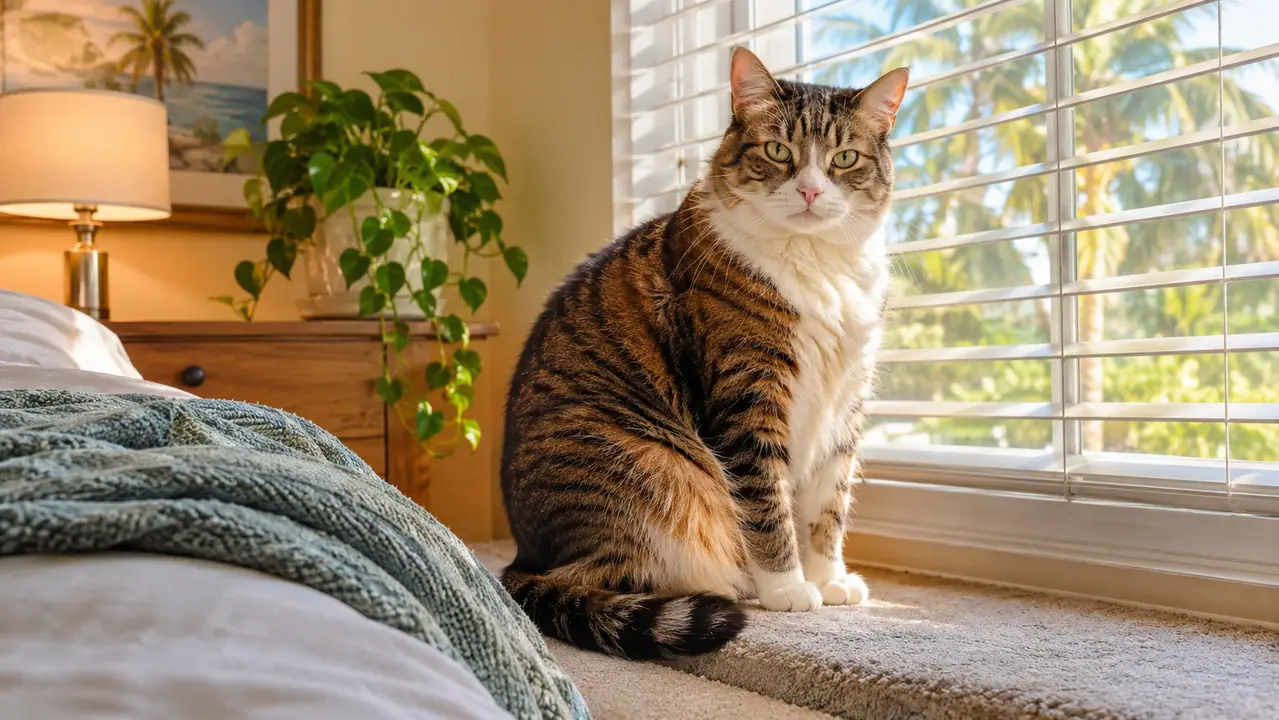
Biscuit is a 14-year-old orange tabby, about 11 pounds, and for most of his life he treated the bedroom windowsill like his personal office. Then last winter he just stopped. Not dramatically. He would sit on the floor underneath it, look up, and then walk away. Around the same time I noticed him taking the stairs to the lanai one at a time, front paws first, back legs following like they had to be talked into it. Our vet diagnosed mild arthritis in his hips and back legs and suggested we try a joint supplement before we talked about anything stronger.
I spent 22 years as a veterinary technician before I retired, so I have opened a lot of supplement bottles in my life. I know what these products can reasonably do, which is support comfort and mobility, and I know what they cannot do, which is reverse arthritis. We started Biscuit on Nutramax Cosequin for Cats in February and I kept notes. This is what five months of daily sprinkles actually looked like in one house with one cat.
The Quick Verdict
A genuinely easy supplement to give a cat, with the two ingredients vets most often reach for at reasonable levels. It will not rebuild a joint, but it may make the daily math of moving around a little less costly.
Amazon Check Today's Price →Biscuit's windowsill habit came back before his x-rays changed
Cosequin for Cats is a chicken-flavored sprinkle capsule: crack it open, mix the powder into wet food, done. 80 capsules per bottle. If your cat has started hesitating at the jump, this is the version most vets hand you first.
Amazon Check Today's Price on Amazon →How I've Used It
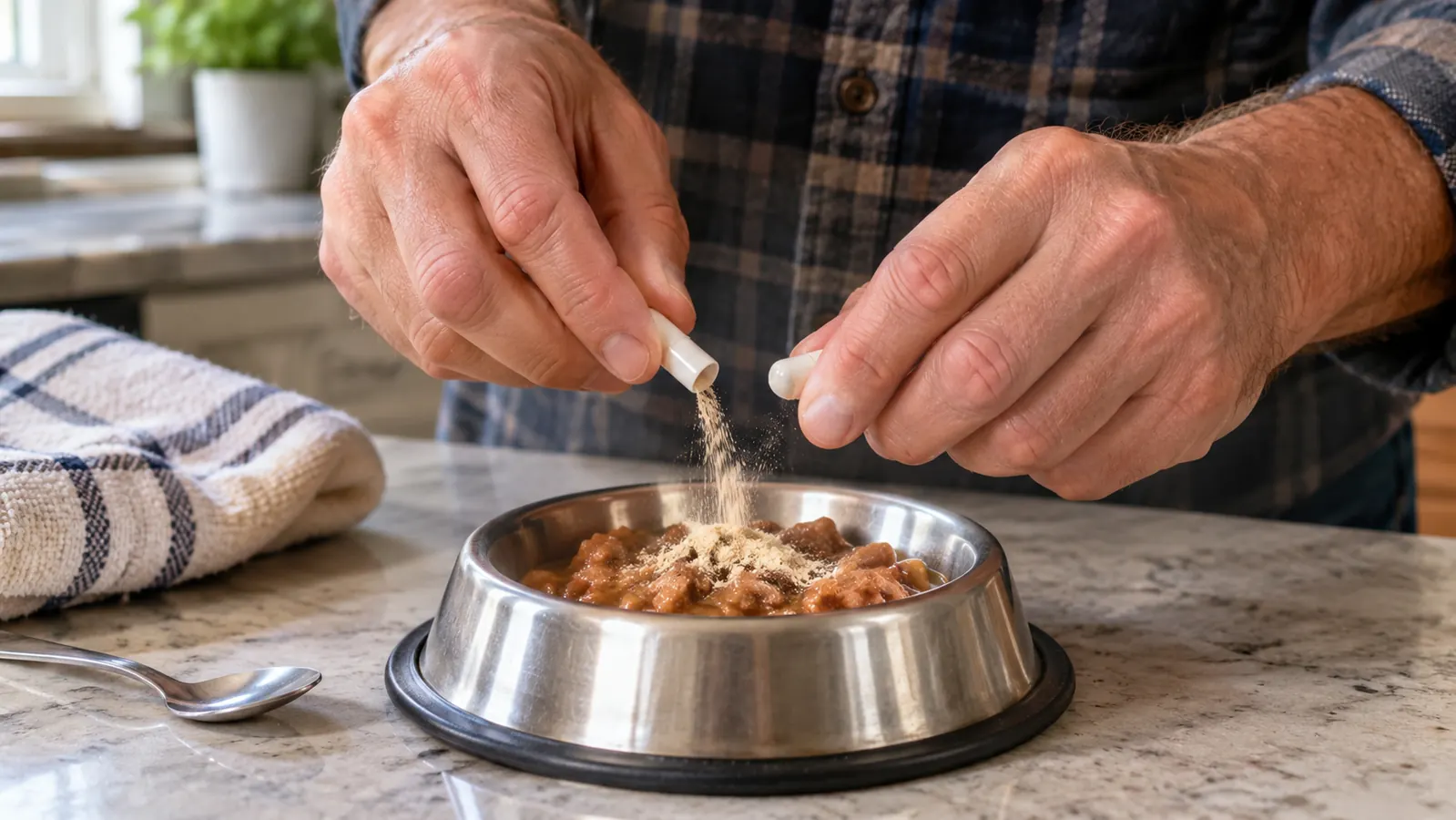
Our vet's instructions were simple: one capsule a day for the first four to six weeks as a loading period, then evaluate. Cosequin sprinkle capsules are not swallowed whole, at least not in this house. You twist the capsule apart and empty the powder onto wet food. Each capsule carries 125 mg of glucosamine hydrochloride, 100 mg of sodium chondroitin sulfate, and manganese. The powder is fine and pale and it disappears into a pate pretty quickly.
That first month was the part I was worried about, because Biscuit is a cat who notices things. He notices when the kibble bag changes. He notices when I move a chair. I fully expected him to sniff the bowl and stage a protest. He did not. The capsules are chicken flavored, and while I would not call the smell appetizing to a human, Biscuit treated the doctored bowl exactly like the undoctored one. I mixed it into about half a can of pate, stirred until there was no visible powder, and set it down.
The practical wrinkle is that the dose has to go into something he will finish. On a fussy day, when he eats half a bowl and walks away, some of the dose walks away with it. I started giving the supplement meal in a smaller portion so he would clean it up, then topping him off with plain food afterward. That solved it. If your cat is a grazer who nibbles all day, ask your vet whether splitting the capsule across two small meals makes more sense.
I weigh Biscuit on the same kitchen scale every other Sunday, mostly because our vet asked me to, and the numbers are on the back of the notebook page where I track his food. February he came in at 11 pounds 3 ounces. By mid-March he was 11 pounds even, and it has held within two ounces of that since. I mention it because I do not want anyone reading this to think a supplement works in a vacuum. The bowl portion and the number on the scale are part of the same picture, and a cat carrying extra weight on sore hips is paying a tax on every jump he considers.
What's Actually in the Capsule
This is the part I care about most, because I spent two decades watching owners get sold powders with impressive labels and nothing measurable inside. Cosequin's label is short. Glucosamine hydrochloride at 125 mg, sodium chondroitin sulfate at 100 mg, and manganese. That is the whole active list. No herbs, no fillers dressed up as actives, no proprietary blend hiding the doses.
Glucosamine and chondroitin are the pair most small-animal vets reach for first when a client asks about joint support. They are building blocks connected to cartilage, and the thinking is that supplying them may help the body maintain what it has. Nutramax has been making this formula for over 25 years, and the brand is the one most vets I worked with kept behind the counter rather than on the retail shelf. That history is not proof of anything by itself, but when I am choosing between two bottles I have never seen a difference with, I lean toward the one my colleagues actually stocked.
What I want to be honest about: this is support, not treatment. Nothing in that capsule slows the progression of arthritis. There is no ingredient in any bottle that does that. What a supplement can plausibly do is make the inflamed, stiff part of moving around a bit less punishing, which changes how willing a cat is to try. That distinction matters, and any product page that blurs it is selling you something that does not exist.
The bottle itself is small enough to sit on a shelf beside a coffee mug without taking up space, about 1.75 inches square and 3.5 inches tall, and it holds 80 capsules. Nutramax recommends keeping it somewhere dry and out of the light, which in a Florida house means not the counter by the sink and not the windowsill it is meant to help Biscuit reach. The capsules are a two-piece gelatin shell, and the whole bottle is a little under an ounce and a half. I keep ours in the cabinet over the coffee maker next to the can covers, and after five months that has become the same automatic reach as the food scoop.
What Changed, and When
I kept a notebook because I am that person. Weeks one through three, nothing. I want to say that clearly, because I have read reviews where owners report a transformed cat in four days and I do not think that is how this works. Biscuit ate his food, took his stairs one at a time, and slept in the same three spots.
Sometime in week five, Ray said, "Is he on the windowsill?" He was. Not jumping up in one motion the way he used to, but he had found a way: front paws to the lower sill, a pause, then up. Over the following weeks that pause got shorter. By week nine he was getting up there most mornings again, and he had started meeting me at the lanai door instead of waiting for me to come to him.
I want to be careful about what I am claiming. Five weeks is right in the window where the loading period ends, which is suggestive but not proof. Cats have good weeks and bad weeks. The weather warmed up in April, and warm weather is kinder to stiff joints than a cold snap. I did not run a controlled trial. I ran a house with one cat in it, and I wrote down what I saw.
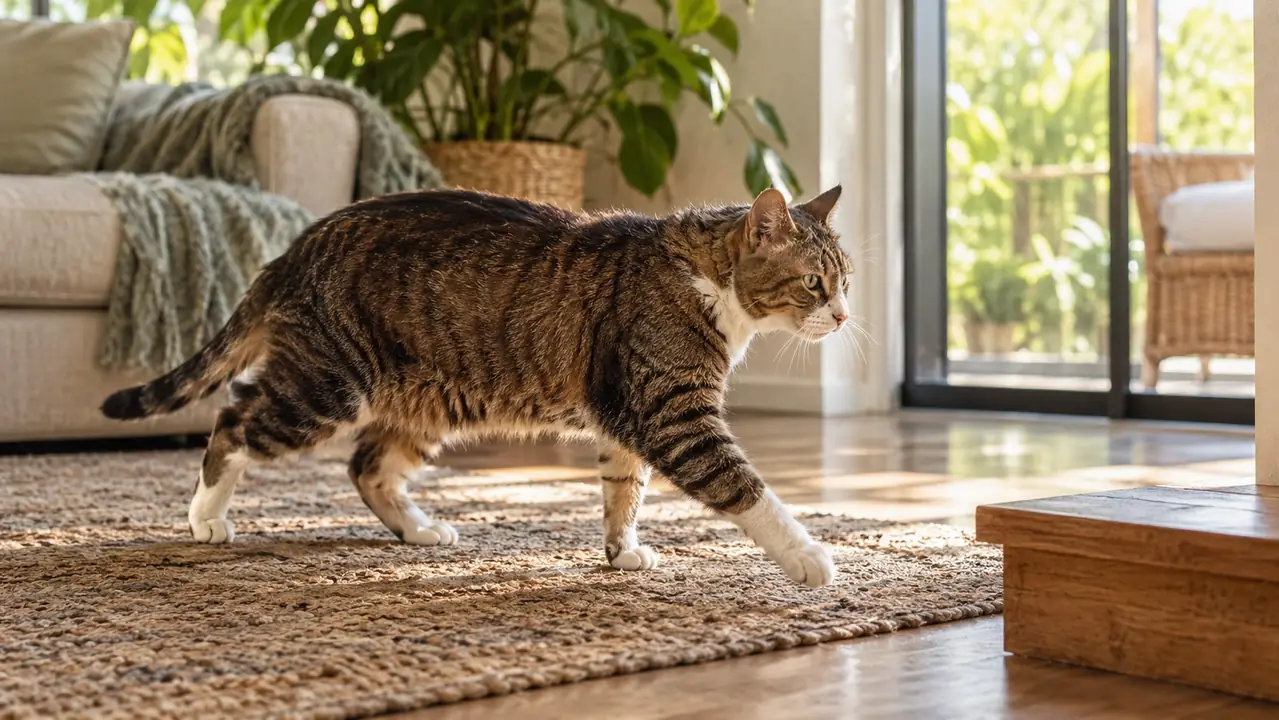
What I can say is that between February and July, Biscuit went from hesitating at the stairs to using them without a visible pause, and from avoiding the windowsill to claiming it again. Those were the two things I most wanted back. The litter box, which had been his other sore spot, stopped being a place he stood in for a long time deciding whether to bother.
One concrete marker, because a timeline of feelings is not much use to anyone. In mid-February I timed him on the lanai stairs one afternoon with the stopwatch on my phone, and his whole trip from the kitchen doorway to the top of the steps took eleven seconds, with two full stops. The same walk on a Sunday in late June took six seconds and he never came to a complete stop. That is not a laboratory measurement and I am not presenting it as one. It is a number taken twice, five months apart, in the same house, by the same person, on the same cat.
By week nine he was getting up on the windowsill most mornings again, and he had started meeting me at the lanai door instead of waiting for me to come to him.
The capsule Biscuit gets is the 80-count sprinkle bottle
Chicken flavored, easy to open, mixes into wet food without a fight. One capsule daily during the loading period, then per your vet's direction. Most cats take it without noticing, which is the whole battle with a cat.
Amazon See the Cosequin Sprinkle Capsules on Amazon →The Fussiest Part of Giving It
I want to spend a minute on the logistics, because the supplement only works if it goes in the cat. The bottle is small, about 1.75 inches by 3.5 inches, and it holds 80 capsules. Each capsule is a two-piece gelatin shell. You pinch the ends, twist, and the halves come apart. It takes about two seconds once you have the motion down.
The trouble is the powder clumps if the food is dry. Mixed into pate it vanishes. Stirred into shredded food with a lot of gravy it mostly vanishes but can leave a faint grit at the bottom of the bowl. On kibble it sits on top and looks exactly like a foreign substance, and Biscuit is not fooled by that. If your cat eats only dry food, my honest suggestion is to use a small amount of wet food as the delivery vehicle, or ask your vet about a liquid form instead.
The chicken flavoring is real but mild. It did not draw Biscuit in and it did not push him away. What matters more is the food it goes into. Any cat who likes their wet food will probably take this without a debate. Any cat who is suspicious of bowls in general will be suspicious of this too, and no flavoring fixes that.
The one genuine annoyance is my hands, not the cat. I have arthritis in my thumbs, which is an irony I am aware of, and a small gelatin capsule is exactly the size that wants to skitter across a countertop. My workaround is a saucer with a lip. I set the capsule in the saucer, hold the top half between my thumb and the side of my index finger, and twist. The saucer catches the bottom half and the powder goes into a bowl instead of onto the floor. If your hands are not what they were, skip the over-the-bowl method and use a dish.
Pros, Cons, and the Things I'd Change
What I Liked
- Short, legible active list: glucosamine HCl 125 mg, sodium chondroitin sulfate 100 mg, manganese
- Sprinkle capsule format works for cats who will not take a pill
- Mixes cleanly into wet food with no detectable texture change
- Chicken flavor did not put off a cat who is picky about food
- 80 capsules per bottle, so the loading month and beyond are covered
Where It Falls Short
- Powder clumps on dry kibble and is easy for a cat to refuse
- Dose is lost if your cat does not finish the bowl
- It supports comfort and mobility; it does not treat or slow arthritis
- Capsules are small and easy to fumble if your hands are arthritic, like mine
- Results take weeks, so you have to commit before you know if it works
What It Won't Do
I have had this conversation hundreds of times, so let me have it here. A joint supplement is not pain control. If your cat is hiding, yowling when picked up, refusing to eat, or avoiding the litter box entirely, that is a vet visit, not a bottle of capsules. Arthritis that has progressed to the point of visible pain usually needs a real plan, which may include prescription medication, weight management, and changes around the house.
I also want to mention weight, because it is the lever most owners skip. Biscuit is 11 pounds and our vet wants him closer to 10.5. Every extra ounce on a cat with bad hips is a tax paid on every jump. We cut back his portions slightly in March and that did as much for him as anything in the bottle. If your cat is carrying extra weight, the supplement and the scale work together.
The other thing worth saying is that Cosequin is not the only format. There is a liquid, and there is a soft chew, and some cats will take one and not the other. I have written about how the sprinkle capsules compare to the liquid form elsewhere, and the short version is that it depends entirely on how your cat eats.
Who This Is For
This is for the owner of a middle-aged to senior cat who has started hesitating before a jump, taking stairs one step at a time, or standing in the litter box longer than they used to. That cat should see a vet first, because there are other things that look like arthritis, and a diagnosis matters before you start buying bottles. Once you have that diagnosis, this is a reasonable first supplement to try, and it is the one most vets will name if you ask.
It is also for the owner who has already tried a pill and lost the fight. The sprinkle format exists for exactly that cat, the one who eats around a tablet and leaves it in the bowl. Five months in, I still open a capsule every morning and I have not once had to wrestle Biscuit over it.
Who Should Skip It
Skip it if your cat eats only dry food and refuses anything wet. You will fight the powder every day and lose half of it. Ask your vet about a liquid instead, or about whether a soft chew is easier to hide.
Skip it if you are looking for something fast. This is a weeks-to-a-month proposition, and if you want to know by Friday whether it works, you will be disappointed and you will have spent money to learn that. Skip it too if your cat is already showing signs of real pain rather than stiffness. That cat needs a vet appointment before anything else, and possibly prescription medication. And skip it if you have not had a diagnosis. A supplement aimed at the wrong problem is just an expensive habit.
One more, and I mean this kindly. If you are expecting a cure, no product on that shelf will give it to you. What Cosequin offers is a plausible, well-documented attempt at making a stiff cat's day slightly easier. For Biscuit, it appears to have done that. I will keep buying it, and I will keep telling owners to call their vet first.
Biscuit got his windowsill back. Your cat's version of that is worth a try.
80 chicken-flavored sprinkle capsules. Mix into wet food, once daily, and give it five weeks before you judge it. Ask your vet about dosing for your cat's weight before you start.
Amazon Check Today's Price on Amazon →