
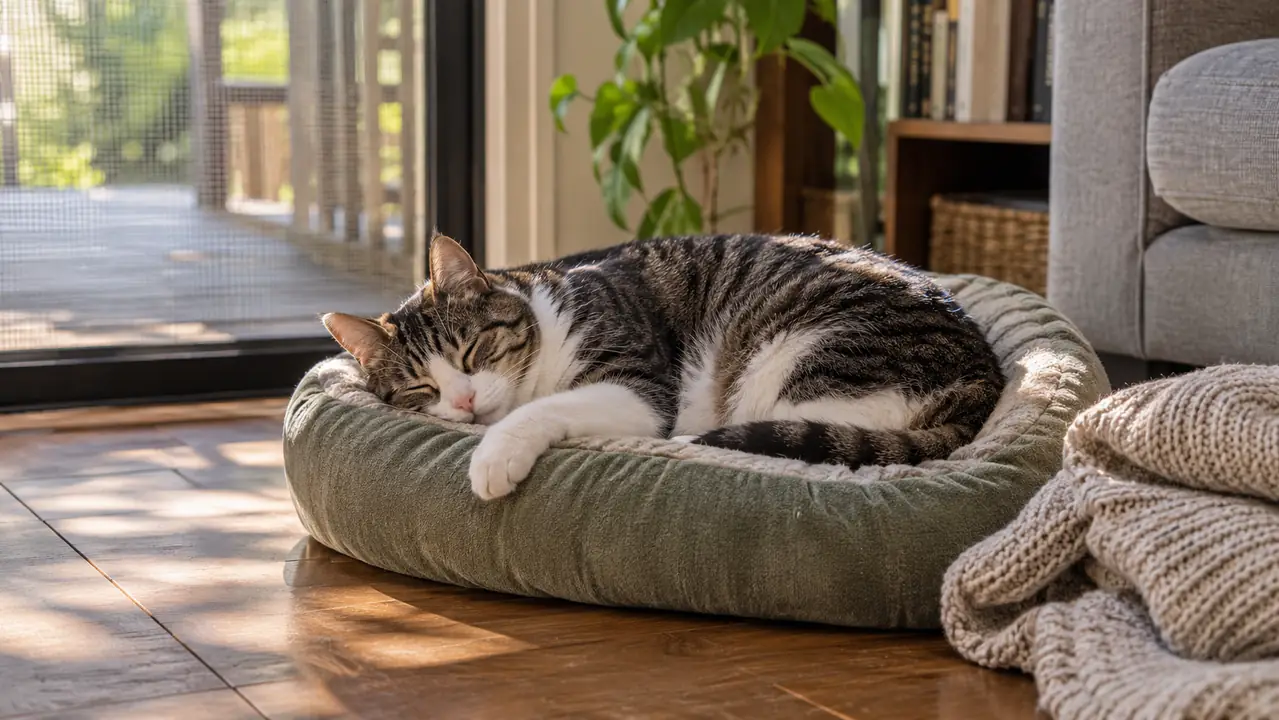
Biscuit stopped jumping onto the bedroom windowsill last spring. He did not fall. He did not cry out. He just started sitting on the floor underneath it and looking up, and then he started taking the stairs one at a time, front paws first, back legs second, like a cat doing arithmetic. I spent 22 years as a veterinary technician, so I knew what I was watching. I also knew that a 14 year old orange tabby with mild arthritis in his hips and back legs was not going to sudden death from cold tile. But I did not like the way he moved in the morning, before the house warmed up.
So I tried the cheap fixes first, because that is what most of us do. I stacked two blankets in his spot. I put a hot water bottle under a towel, which cooled off in about forty minutes and made me nervous the whole time. I bought a self warming pad that turned out to only reflect whatever body heat he brought with him, which is not much help to a cat who is already cold. Then I bought the K&H Pet Products Thermo Kitty Bed, and the thing that made the difference was not the heat. It was placement and patience, which is what this whole article is about.
The bed that ended up under Biscuit's abandoned windowsill
A 20 inch heated cup with 6 inch foam walls, a 4 watt heater, and a thermostat that only warms when a cat is actually in it.
Amazon Check Today's Price on Amazon →Step 1: Get the arthritis diagnosis and pain plan in place first
Arthritis is a diagnosis, not a guess, and the difference matters once you start adding heat to a cat's daily routine. Our vet confirmed Biscuit's hips and back legs in early 2024 with a hands on exam and x rays, and put him on a plan that includes a monthly injectable and a joint supplement. If your cat has not been examined, book that first. Cats hide pain better than any species I worked with, and a cat who stops jumping might be dealing with dental pain, an overactive thyroid, or high blood pressure. A warm bed does nothing for any of those.
There is a safety reason to start at the clinic, too. Heat raises skin temperature, and a cat with certain heart conditions, or a cat who cannot move himself off a hot surface, is not a good candidate for a heated bed at all. Ask the question plainly: is heat fine for this cat, and is there a limit on how long he should use it? Write the answer on the receipt and stick it to the fridge. I say that as someone who spent two decades watching owners try to recreate discharge instructions from memory in a parking lot.
While you are there, ask for two more things that cost nothing. Ask the vet to write down your cat's current weight and body condition score so you have a baseline to check at home. And ask whether the pain plan should be reviewed on a schedule, because arthritis does not hold still and a dose that fit in March may not fit in October. Biscuit gets weighed at every recheck and we keep the slips in a folder. It sounds fussy. It is the only way I know to catch a slow slide before it becomes a bad month.
Step 2: Match the bed to the cat, not to the product photo
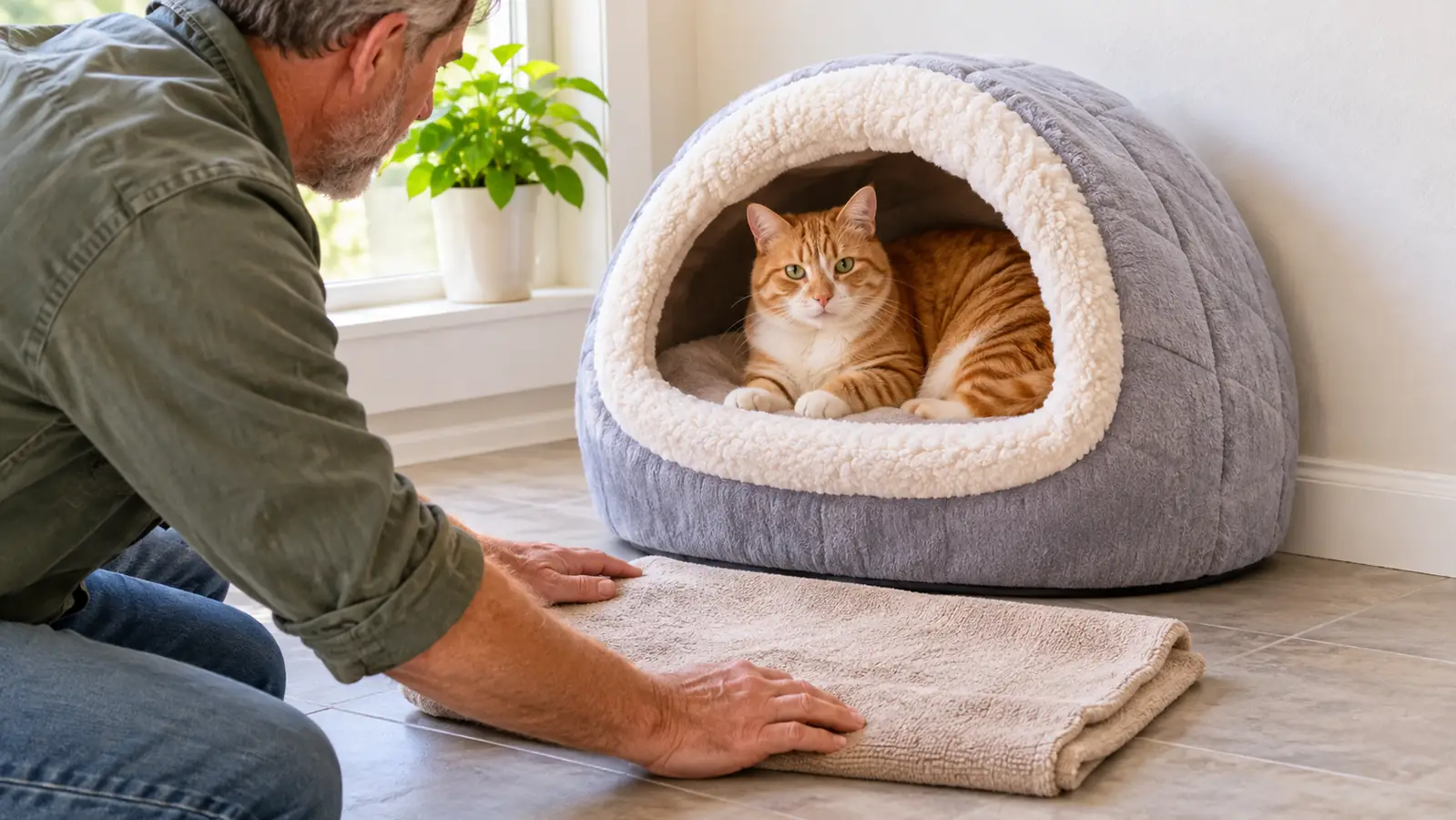
The bed comes in a large 20 inch size, and the numbers worth knowing for a stiff cat are these: 20 x 20 x 6 inches, about 1.9 pounds, with 6 inch tall soft foam walls. Those walls are what make the bed feel like a den, and they are also the part you need to think about. A cat with sore hips does not always want to step over a 6 inch lip to reach the warm part. If your cat still jumps, just slower, the walls are fine. If he hesitates at the edge like Biscuit did, fold a bath towel flat on the floor in front of the opening so the first step up is half as high.
The rest of the build is simple in a way I appreciate. It weighs about 1.9 pounds, so it slides from room to room instead of fighting you. The heater is 4 watts, low enough to leave running all day without thinking about it, and it is removable, so the bed keeps working as a plain cushioned bed if the heater ever gives out. K&H Pet Products backs it with a one year limited manufacturer warranty. Read the size line twice before you order. Twenty inches across is a medium bed, and a big boned 15 pound cat will fill it rather than curl inside it.
Step 3: Put it where the cat already rests, not where you want it
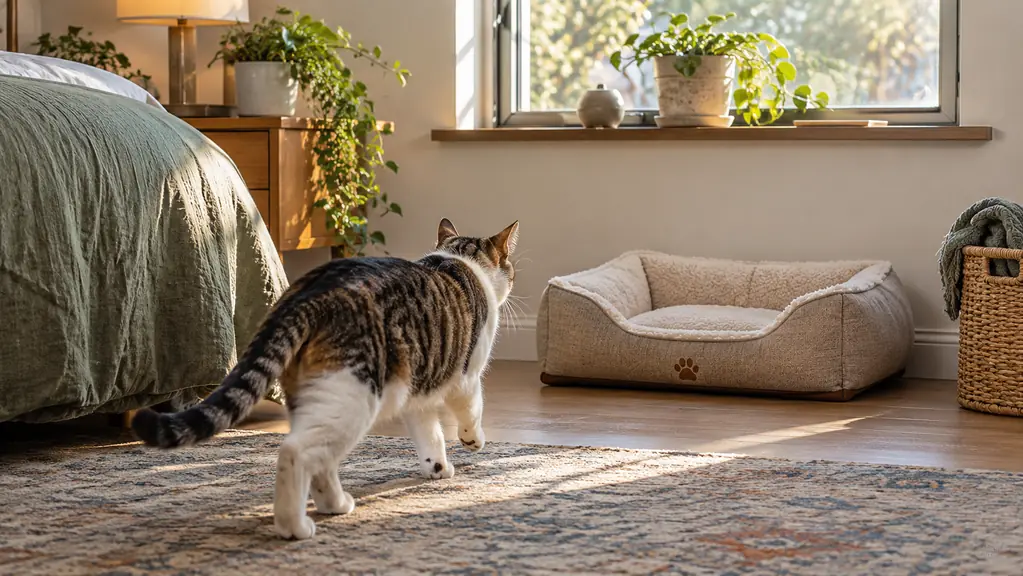
Watch your cat for two days and write down the three places he sleeps. Not the places you would prefer. The places he chooses. For Biscuit that was the tile in front of the lanai door in the afternoon and the corner of the bedroom rug at night. The bed went to the bedroom corner, against the wall, out of the ceiling fan's path and away from the door we open and close a hundred times a day.
Cats are conservative about new furniture. A heated bed in the middle of a hallway will sit empty for a week while your cat sleeps on cold tile two feet away, and then you will decide the bed does not work. Put it against a wall, ideally in a corner, ideally somewhere he can watch the room from. If you have a low windowsill perch he has abandoned, set the bed directly underneath it. That is exactly what I did. Biscuit cannot get up to the sill anymore, but he still wants to be where the sill is, and the bed under it got used on the first night.
One more thing about placement that took me a while to learn. Do not move it once he starts using it. I moved Biscuit's bed two feet to vacuum one Saturday and he did not touch it again for three days. A cat who is already sore is not looking for novelty. Pick the spot carefully the first time, then leave it alone, and vacuum around it instead of under it.
Step 4: Test the surface with your hand, then give it three nights
Feel the surface with the back of your hand before you plug it in, then plug it in and feel it again after ten minutes with the bed empty. The thermostat in this bed is designed to warm only when a pet is inside it. When the bed is empty, the surface stays at or just above room temperature. So an empty bed will feel barely warm, and that is normal. It is not a broken heater. It is the reason the thing is safe to leave plugged in while you are at work.
The real test is the cat, not the thermometer. Give it three nights. On night one, put a worn t shirt of yours in the bed so it smells like the house. On night two, if he still has not tried it, set him in it after a meal when he is sleepy and let him leave on his own. Do not hold him there, and do not stand over him. On night three, if he is using it, stop fussing. If he is avoiding it completely, move it to the next spot on your list before you blame the bed.
The heater is 4 watts and it only warms when a cat is lying on it. That is the whole reason this thing can stay plugged in all day.
Step 5: Wash the cover, check the cord, and watch the cat
The cover comes off for washing, and you will wash it more often than you expect. Arthritic cats groom less, and a cat who leaks a little urine after lying on a warm surface will make that bed smell faster than you would believe. Gentle cycle, dry it completely, and never put the heater in the machine. Pull the heater out first, every single time, and run your hand around the inside of the empty cover before you zip it back up.
Once a week, run your hand along the cord from the bed to the outlet. Look for a chewed spot, a hard kink, or a plug that feels warm at the wall, and check the foam walls for a tear that has opened down to the heater. This bed is safety listed and the one year limited warranty covers manufacturing defects, but none of that covers a cord a cat has been working on for a month. If anything looks wrong, unplug it and stop using it.
Watch the cat as closely as you watch the cord. A cat who stays on the bed for hours and then moves stiffly, or pants, or feels hot to the touch, is telling you something. Biscuit settled into two long naps a day plus a stretch in the evening, and he gets off on his own. A cat who cannot get off on his own should not be on a heated bed unsupervised. That is not a small point. It is the whole reason you ask the vet first.
What Else Helps
Warmth is one piece of a plan, and it is not the plan. Biscuit's pain management comes from our vet, and it gets reviewed at his rechecks, because arthritis does not hold still. His weight matters as much as anything. He is about 11 pounds and we work to keep him there, since every extra pound on a cat with sore hips is a pound he carries up the stairs. If your cat has gained weight, ask about a measured feeding plan at the same visit. It is unglamorous and it is the single most effective thing most owners can change.
Then look at the house through a stiff cat's eyes. Slick tile is hard on sore joints, so put a runner down on the path he uses. Move a litter box to the floor he actually lives on, and choose one with a low entry, because a high sided box is a wall to a cat with sore hips. A sturdy step or a low stool gets him onto the sofa or the bed without the jump. Brush him gently a few times a week, since the back half is exactly where an arthritic cat stops reaching.
And skip the shortcuts that feel warm but are not safe. A hot water bottle wrapped in a towel cools within the hour and can burn skin before it does. A heating pad made for people has no thermostat that knows a cat is lying on it, and a cat will not always move off a surface that is too hot. Never leave a space heater running in an empty room for a cat's benefit. That is why the only heated thing I leave plugged in when I go out is the K&H Pet Products bed, with its thermostat and its 4 watt heater doing the deciding instead of me.
One honest note about expectations. A heated bed may help your cat rest more comfortably and move a little easier after a nap. It does not treat arthritis, it does not reverse anything, and it will not replace medication your vet prescribes. What it did for Biscuit was make the mornings less stiff and put him back in the bedroom with us instead of on the cold tile by the door. That is a small thing and it is also the reason I bought a second K&H Pet Products bed for the lanai.
Start with the corner he already sleeps in
Set it against the wall, lay a towel in front as a step, and give it three nights before you decide. That is the whole method.
Amazon Check Today's Price on Amazon →