
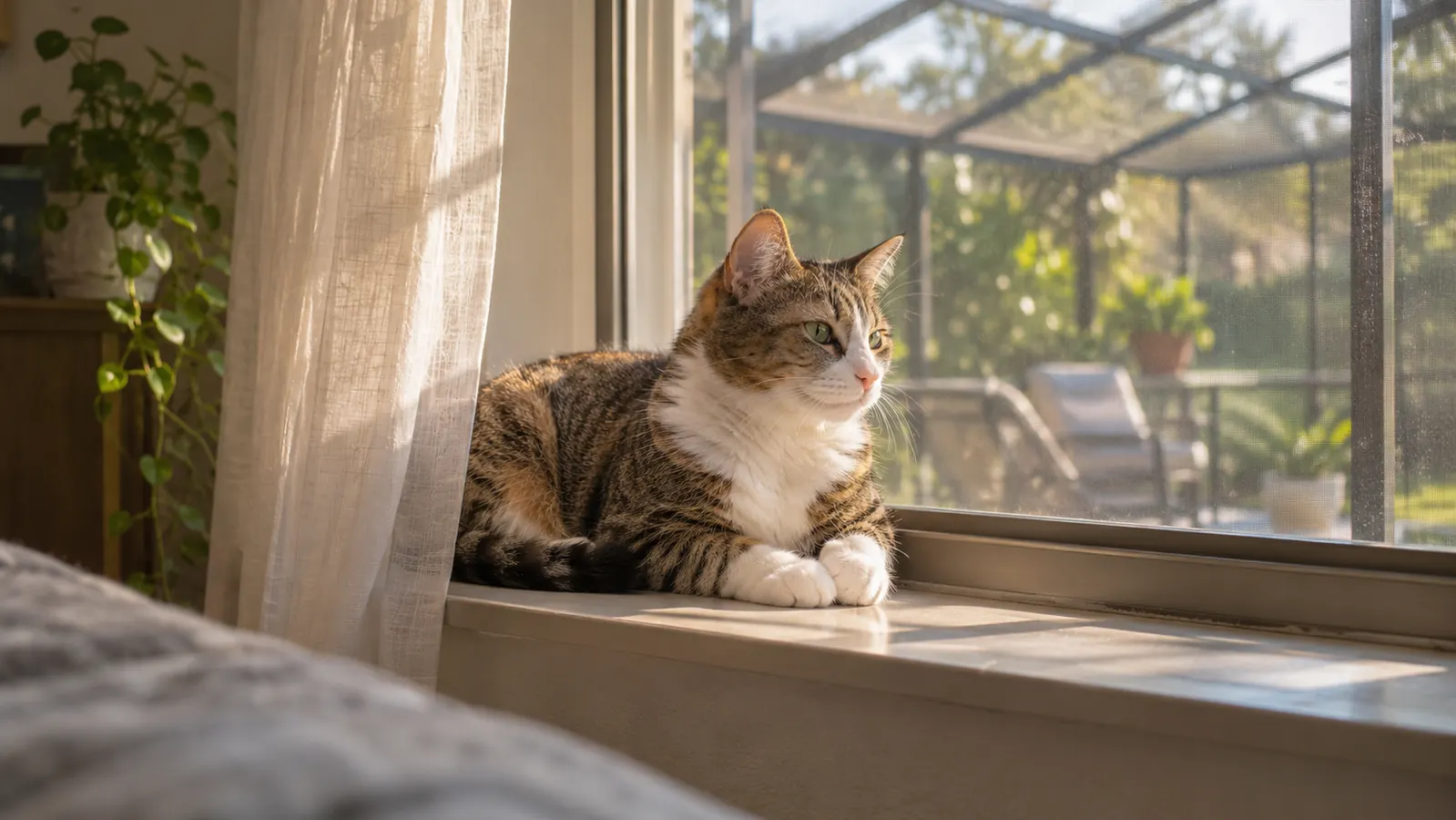
The first thing nobody tells you about pet stairs is that the stairs are not the hard part. Biscuit, my 14-year-old orange tabby, weighs about 11 pounds and was diagnosed with mild arthritis in his hips and back legs by our vet last year. The day I noticed he was taking the couch in two separate moves instead of one, I did what most people do and ordered a set. The aodisman 3-Step Pet Stairs arrived flat in a box, weighing 4.3 pounds, and sat on my lanai looking like a folded cushion for three days. That waiting period is the part I want to talk about, because it is the part the product page mentions in a single line and the part that decides whether your cat ever uses the thing.
I spent 22 years as a veterinary technician, and most of what I know about mobility aids came from watching clients waste money on the wrong one. A cat does not care about your intentions. He cares about whether a surface feels stable under his back feet at the moment he commits his weight to it. So this is not a review that tells you the aodisman stairs are wonderful. It is a review that tells you what they are, what they are not, and which cats will walk up them on day one and which cats will ignore them until you move them somewhere else entirely.
The Quick Verdict
A firm three-layer foam step set that a small cat will trust within a week, if you give it the full 48 to 72 hours to expand first and then put it where the cat already wants to be.
Amazon Check Today's Price →The stairs only work if your cat trusts them, and trust starts with three days of waiting
Three foam steps, 4.3 pounds, a corduroy cover that gives paws something to grip, and a 60 pound limit. Let it puff up before you judge it.
Amazon Check Today's Price on Amazon →How I've Used It
The stairs live in the bedroom, angled toward the low windowsill Biscuit used to reach in one motion. That windowsill is the whole reason I bought them. Everything else in our one-story house he can manage without help, but the sill sits high enough that he had started parking himself on the floor underneath it, looking up the way you look at a staircase when your knees hurt. The aodisman set stands 15.7 inches tall at the top step, which put it almost level with the sill, and that mattered more than any other number on the page.
Before I settled on the stairs I tried the cheap fix first, which was a wooden footstool from the hall closet. It was 14 inches high, single step, solid, and Biscuit hated it. He put both front paws on it, felt the smooth top, and backed off. Two weeks of that stool sitting beside the sill and he never once used it to get up. The problem was the surface and the fact that one 14 inch hop is still a hop. Three foam steps split that same height into pieces small enough for him to take one at a time, and the corduroy gave him something his claws could actually catch. The stool went back in the closet and I have not missed it.
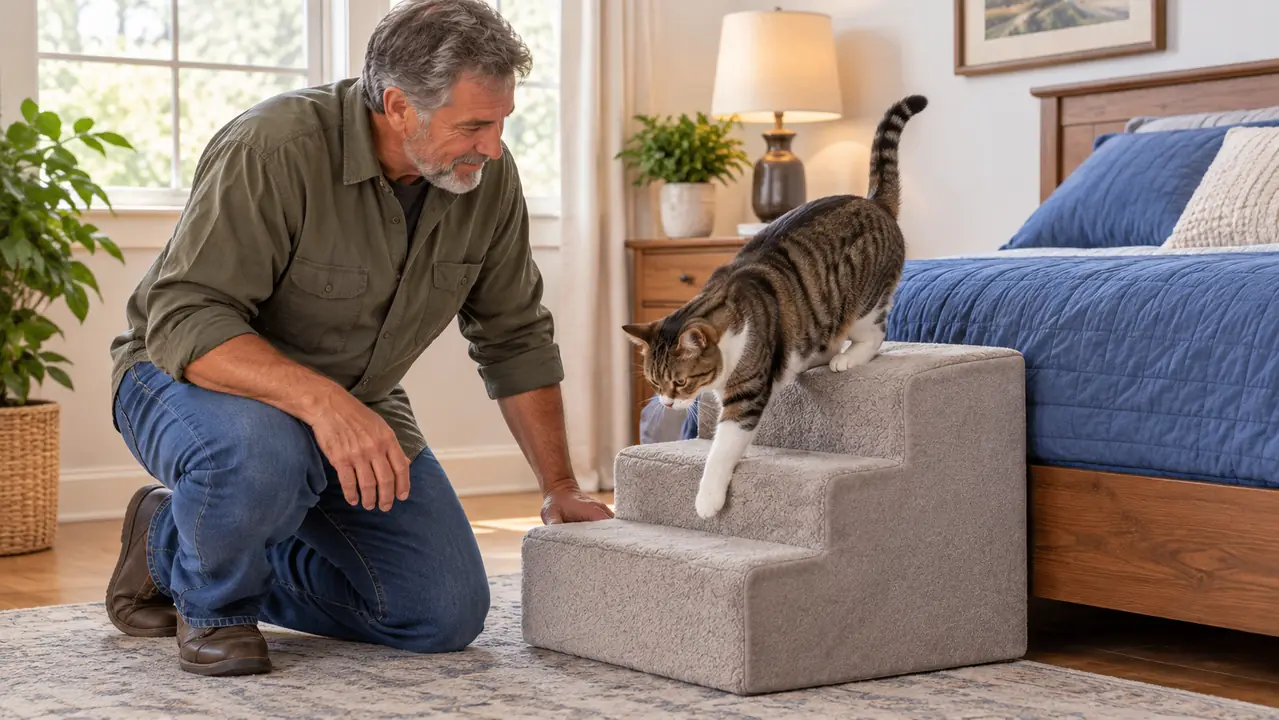
For the first two days he ignored the stairs completely. On the third day he put one front paw on the bottom step, decided against it, and walked away. On the fifth day he went up all three steps without pausing, sat in the afternoon sun for twenty minutes, and came down the same way. That is the timeline I now give any cat owner. Not instant, not a week, somewhere in the middle. Dogs tend to take to a new step set in an afternoon. Cats audit it first, and they do not care that you are watching.
The Unfolding Is Not a Gimmick, and It Is Not Instant
The stairs ship compressed. The listing says the foam needs 48 to 72 hours to pop up and hold the shape of a staircase, and I want to be blunt about that, because it is the single most common reason people leave a harsh review on a foam product. Out of the box it looks like a folded pad with three shallow creases. If you put your cat in front of it during hour one, he is stepping onto a soft sagging wedge, and he will not try it a second time. I set mine out on a Thursday morning, cut the plastic, worked the creases open with my hands the way you would fluff a pillow, and did not offer it to Biscuit until Sunday.
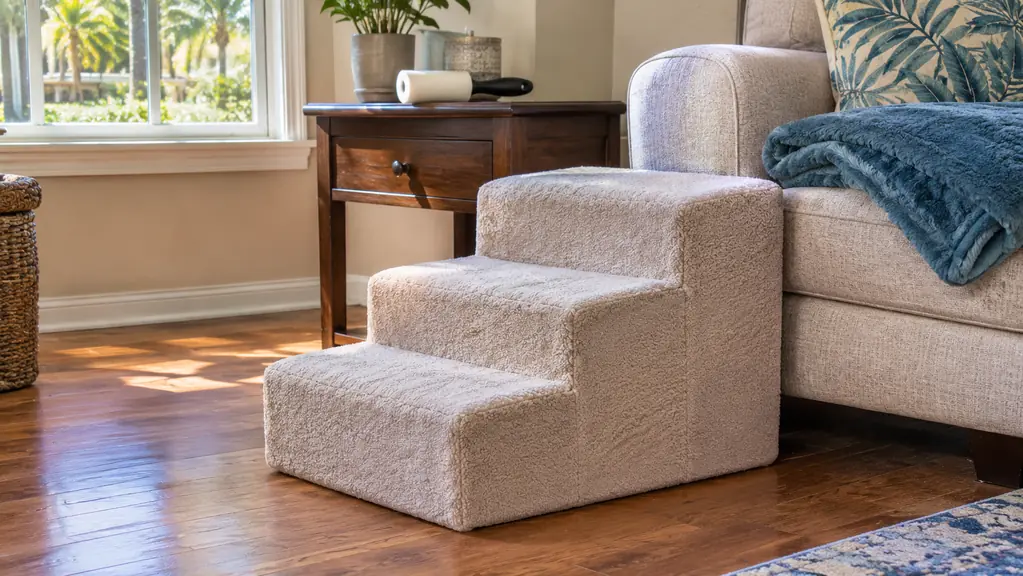
By Sunday the foam had firmed into something with actual edges. Not hard, not bouncy, somewhere in the range of a firm couch cushion. The listing describes three layers of foam, and when you press the top step with your palm it gives a little and then holds instead of bottoming out. The corduroy cover is the part doing the real work for a cat. Corduroy has a nap, a direction to the fibers, and paws get traction on it that they never get on smooth fabric or bare foam. I have watched Biscuit skid on our hardwood and I have never seen him slip on these steps.
What a Cat Checks Before He Commits
A cat evaluates a step the way you evaluate a ladder. He wants to know whether it will move, whether his back feet will land on the same surface his front feet found, and whether the top of it is somewhere worth being. The aodisman steps measure 15.7 inches wide and 22.4 inches deep, which gives a cat room to place all four feet without crowding an edge. That width is why this works for a cat when a narrow decorative step does not. Biscuit is 11 pounds and he uses maybe half the width. A heavier cat would use more of it and still have room.
The stability question is the one I would push on if you were standing in a store with me. These weigh 4.3 pounds. That is light enough to move with one hand and light enough that a determined cat can shift it. Ours sits against the side of the bed frame, so it has nowhere to travel when Biscuit pushes off the top step. On open hardwood it will skate an inch or two under a hard launch. I tested that on purpose one morning, setting the stairs out in the middle of the living room floor to see what would happen. One push off the top step and the whole set slid about two inches toward the rug. Nobody got hurt and Biscuit looked mildly offended, but it told me what I needed to know. That is not a flaw exactly, it is what 4.3 pounds of foam does, but you should plan the placement around it rather than expect the stairs to stay put on their own.
Where It Falls Short
Three things I would tell a friend before she buys. First, the cover is fabric and fabric collects cat hair. The corduroy grabs it in the nap and a lint roller takes several passes to clear a step. I keep one in the side table drawer now and hit the stairs every Sunday, and a full pass takes me a couple of minutes. Second, Biscuit's claws have started to leave faint pulls in the fabric on the top step after about four months of daily use. Nothing has torn and it has not changed how the step performs, but it is not going to look new forever. Third, there is nothing here that holds the stairs to the furniture. Nothing clips and nothing straps. You are relying on gravity and on sensible placement.
And the biggest one, which is less a flaw in the product than a limit on what any set of stairs can do. These do not treat arthritis. They change the angle of the climb. Biscuit still has arthritis in his hips and back legs, and he still has days when he is stiffer than others. The stairs mean he does not have to launch himself to reach the sill, and that is worth something real, but it is management of his environment, not medicine. If your cat cries out when you touch his hips, or he has stopped using the litter box, that is a vet conversation before it is a shopping conversation.
The stairs do not treat arthritis. They change the angle of the climb, and for a cat who has stopped jumping, that angle is the whole point.
Stairs Versus a Ramp, for a Cat Specifically
Ramps are the other option and they solve a different problem. A ramp suits a cat who cannot lift his legs cleanly at all, or one recovering from surgery who has been told not to step up. A set of stairs suits a cat who can still step but should not jump. Biscuit can step. He just cannot launch. The aodisman set asks him for three deliberate steps up to a 15.7 inch top, which is a movement he can make without bracing, and that is the entire reason it worked for him when a single high hop did not.
Ramps also eat floor space, and in a one-story Florida house where the lanai door gets used constantly, floor space is not free. The stairs footprint at 22.4 inches deep fits against the bed frame without blocking the path to the bathroom at two in the morning. If your cat genuinely needs a ramp, though, get a ramp. Do not buy stairs because they are smaller and then wonder why your cat refuses them. The right aid for the wrong cat is a hundred percent waste of money no matter how good the reviews are. A quick ask at your next vet visit settles which one you need, and it costs nothing but the appointment you were already going to.
The Weight Numbers, and Why They Matter Here
The listing gives a 60 pound maximum and recommends the set for pets under 50 pounds. Biscuit is 11 pounds, so he is nowhere near the ceiling and I cannot tell you honestly how the foam behaves at 55. What I can tell you is that the rating is about the foam holding its shape, because the whole thing is foam. A 60 pound dog going up three steps a dozen times a day is asking more of this material than an 11 pound cat is. For cat owners the weight limit is close to a non-issue. Every cat I weighed during 22 years in a clinic came in under 25 pounds, and most were under 15.
The listing notes four steps for sofas and beds and five for high beds, with the three step version for sofas and chairs. That sizing note is worth a second look before you order, because it is the difference between a set that lines up with your furniture and a set that leaves your cat with one last hop to make. Measure the height of the thing your cat is trying to reach before you buy anything. I measured our sill at just over 15 inches, which is why the 15.7 inch top step lined up so cleanly. If your bed sits at 24 inches, three steps will not get you there and the cat will still be jumping off the top one.
The Warranty and the Long Haul
The listing carries a 6 month warranty, which tells you something about how the manufacturer expects the foam to age. Mine is four months in and the top step has not dished where Biscuit pushes off. If it ever does, you will know before you see it, because the cat will start avoiding the stairs he used to take without thinking. That is the moment to use the warranty rather than buy a second set and hope. Foam does eventually give up, and a step set that has gone soft is worse than no step set at all, since it teaches a cat that the surface cannot be trusted.
What I Liked
- Firms into a stable step set once the 48 to 72 hour expansion window finishes
- Corduroy cover gives paws real traction, which is the difference between a cat using it and refusing it
- 15.7 inches wide and 22.4 inches deep, enough room for a cat to place all four feet
- 4.3 pounds, light enough to move room to room with one hand
- 60 pound maximum covers every cat and most small dogs
- 6 month warranty
Where It Falls Short
- Arrives compressed and looks unusable until the foam finishes expanding
- Nothing secures it to furniture, so placement does the work
- Corduroy collects cat hair and shows claw pulls over months of use
- At 4.3 pounds it can slide on smooth flooring under a hard launch
Who This Is For
Owners of senior cats with mild to moderate arthritis who have watched their cat quietly give up a favorite spot. Owners of a cat recovering from a soft tissue injury whose vet has said to limit jumping for a few weeks. Owners of small dogs, since the listing covers both and the dimensions suit a pet up to about 50 pounds. And owners who want a step set they can carry from the bedroom to the couch without help, because 4.3 pounds is genuinely light and the corduroy cover means you are not chasing a separate pad around the house.
Who Should Skip It
Skip it if your cat is a confident jumper with no mobility changes yet, since stairs solve a problem you do not have. Skip it if you have a large dog, because 60 pounds is the stated ceiling and the recommendation sits under 50. Skip it if you need something that fastens to the bed or stays put on a slick floor without help, because this does neither. And skip it if you are not willing to wait the 48 to 72 hours before your pet tries it. Handing a cat a compressed foam wedge is the fastest way to teach him the stairs are not trustworthy, and unteaching that takes far longer than three days.
The Short Version, If You Are Shopping Today
If your cat is a healthy jumper who uses the couch now and then, you do not need this. If your cat has started hesitating, taking the couch in two moves, sitting on the floor looking up at a windowsill, or landing hard on the way down, then stairs are one of the least invasive changes you can make to his day. Buy them, let them sit for three days, put them where your cat already wants to go, and then leave him alone about it. Do not stand there coaxing. Cats read coaxing as pressure, and pressure as a reason to decline.
One last thing on placement, because it made the difference in our house. I first put the stairs where they looked tidy, squared up against the wall and a few inches off the sill. Biscuit walked past them for two days. Then Ray moved them to where they actually lined up with the sill, slightly angled, and that was the afternoon the cat went up. Cats do not care about tidy. They care about whether the top of the set meets the thing they want to reach. Line it up first and worry about how it looks second.
The aodisman set is not the fanciest option on the market and it is not the sturdiest, and for a cat it does not have to be. It is 4.3 pounds of three-layer foam with a corduroy cover, sized so a small animal can place all four feet, and simple enough to try without a long argument with yourself. That combination is why it is still in my bedroom four months later, still holding its shape, and still the reason a 14-year-old tabby gets to sit in the afternoon sun the way he did at six.
Four months in, this is still the set in my bedroom
Three foam steps, corduroy grip, 4.3 pounds, a 60 pound limit and a 6 month warranty. Give it three days to expand, then put it where your cat already wants to go.
Amazon Check Today's Price on Amazon →