
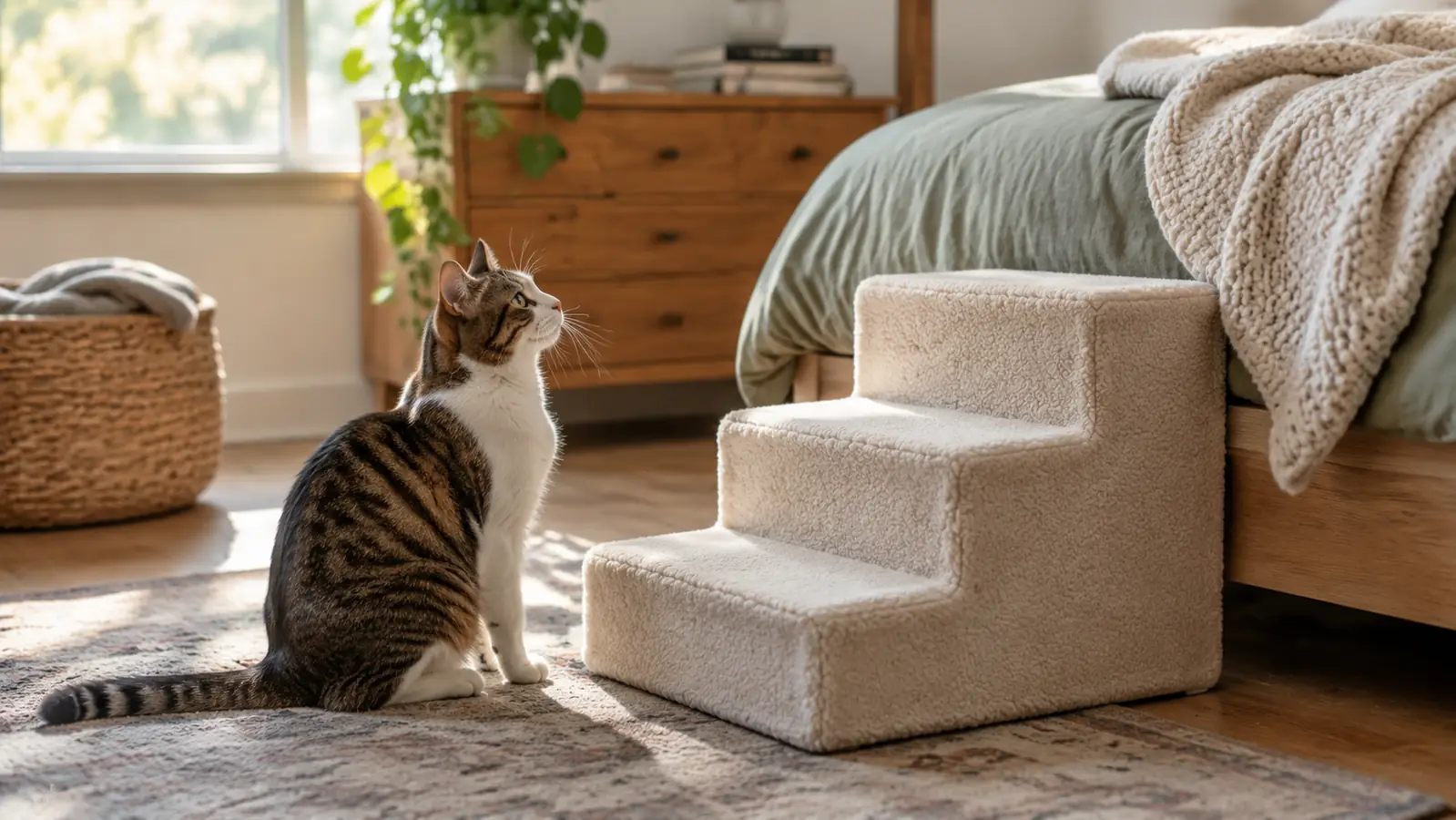
I knew something had changed the night Biscuit sat at the foot of the bed and looked up. He is a 14-year-old orange tabby, about 11 pounds, and for most of his life he cleared that mattress in one silent arc. That night he put a front paw on the frame, thought about it, and sat back down. Our vet found mild arthritis in his hips and back legs a few weeks later. Not a crisis. Just a slow subtraction of the things he used to do without thinking about them.
Pet stairs do not treat arthritis and they will not make a stiff cat limber again. What they do is remove one jump from a cat's day, and for a senior cat that can be the difference between sleeping on the bed with you and sleeping alone on the floor. The set I bought is the aodisman 3-step pet stairs, a foam staircase with a corduroy fabric cover. It took Biscuit nine days to use it without being bribed. Here is the exact sequence I used, the two mistakes that set me back, and what I would tell any owner of an older cat to expect.
Nine days of treats beats one bad landing off the bed
The aodisman 3-step pet stairs is foam, weighs about 4.3 pounds, and measures roughly 22.4 inches deep by 15.7 wide by 15.7 high. The maker lists a 60 pound maximum and recommends it for pets under 50. Three steps suit a sofa or a chair, so measure your bed before you assume it fits.
Amazon Check Today's Price on Amazon →Step 1: Unpack It and Then Leave It Alone for 72 Hours
These stairs arrive compressed, and the listing says the foam can take 48 to 72 hours to fully pop up and unfold into the shape of a staircase. That is not lawyer language. Mine was a lumpy slab on day one, a shallow suggestion of a shape on day two, and a proper set of three steps by the third morning. If you put a half-risen wedge next to the bed on night one and expect a cat to trust it, you have handed him an unstable object at the exact moment he is already unsure of his own footing.
So let it rise somewhere he can watch. I set ours on the bedroom rug, in the path he takes between the door and his water bowl, and left it there. Biscuit sniffed it twice, walked around it, and ignored it for two days. That was exactly what I wanted. By the time it was fully formed, it was already a piece of furniture he had decided was not dangerous, which is most of the battle with a cat of any age.
One thing nobody mentions: compressed foam has a smell. Ours faded inside a week, but if your cat is sensitive, give it the full three days in a spare room with a window cracked rather than in the room where he sleeps.
Step 2: Put It Where He Already Wants to Go
The mistake people make is placing stairs where the stairs look nice. Your cat has spent fourteen years deciding which surfaces are worth the effort, and he has a route. Watch him for one ordinary evening and write down the two or three places he still tries to reach: the bed, the couch, the windowsill perch. Then pick the one he has most recently given up on.
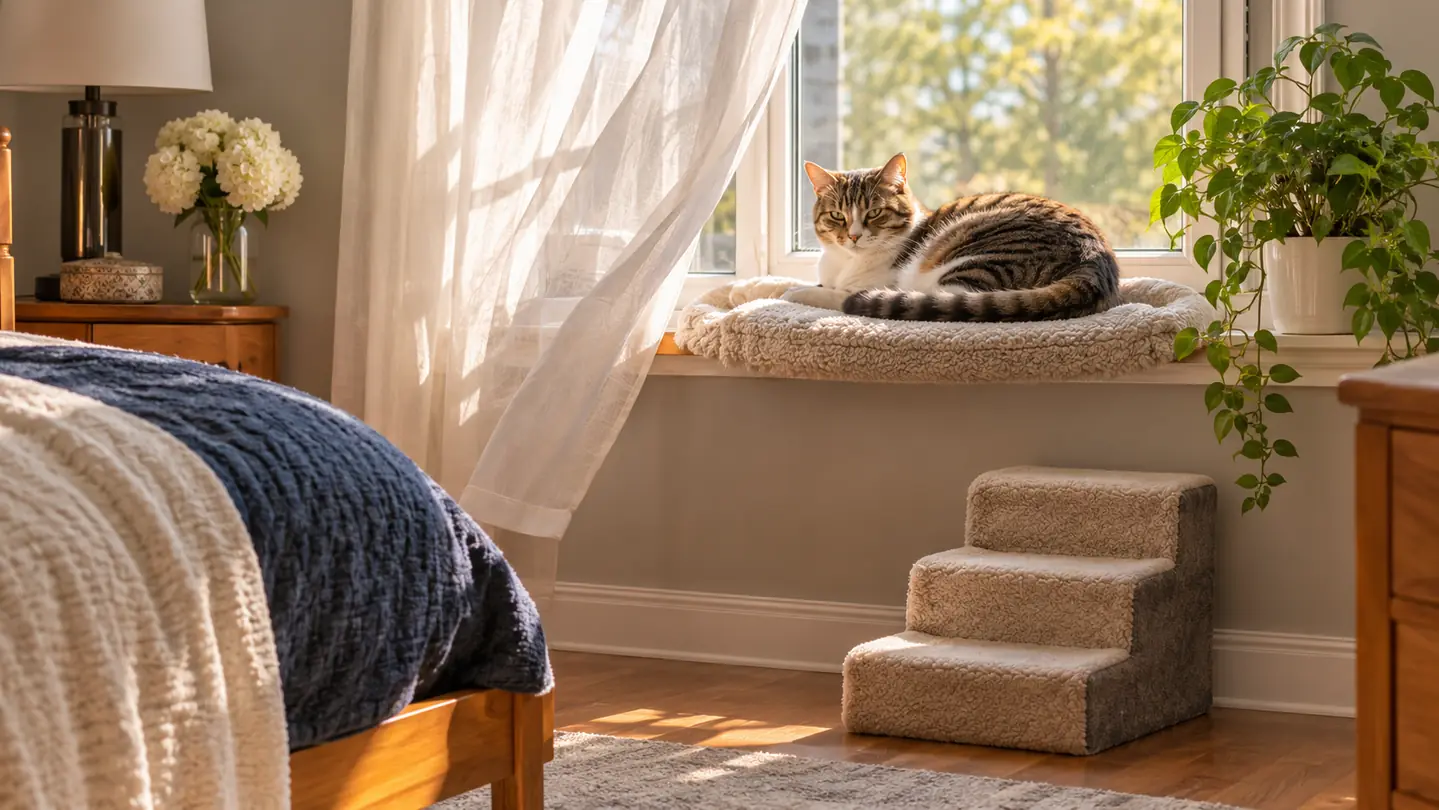
For Biscuit that was the low windowsill perch in the bedroom. He used to spend every afternoon there and had quietly stopped. It sits about sofa height, which is what a 3-step set is designed for. A taller bed may need a 4 or 5 step version, and the maker says as much in the listing. Measure the surface height and compare it to the 15.7 inch height of this set before you buy, because a steep final step undoes everything you are about to do.
Then check the footing. Press the stairs down where they will sit and try to slide them. If they move on a hardwood floor, put a thin rubber mat underneath or move to carpet. The corduroy cover gives paws something to grip, but it cannot compensate for a stair unit that skates when a 14-year-old cat commits his weight to it.
Step 3: Lure With Scent, Never With Hands
Do not pick your cat up and set him on the second step. I have watched owners do this for twenty years and it fails almost every time, because a cat who is placed somewhere has learned nothing about how to get there himself, and he learns that the object grabs him. Let him arrive on his own four feet or not at all.
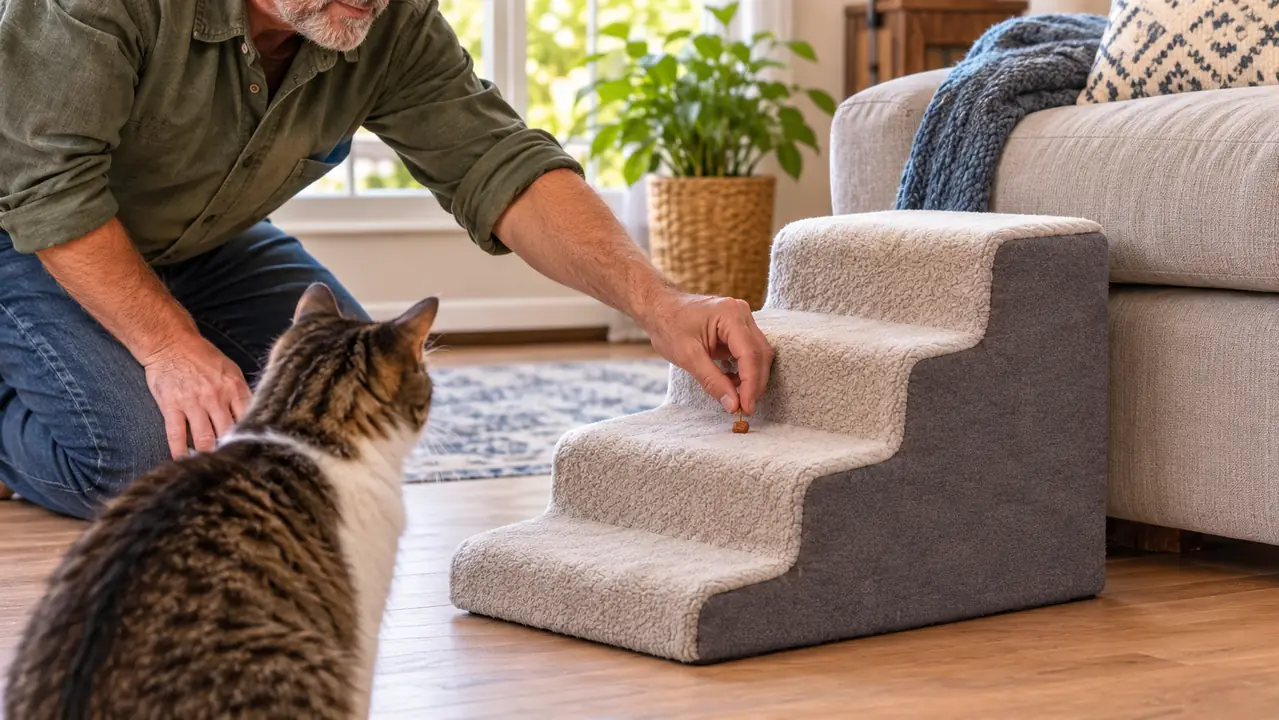
Instead, make the stairs smell like him. I took the towel from the bottom of his carrier, the one with three years of his own scent in it, and wiped down each step and both sides. You can also rub a worn t-shirt of yours along the corduroy. Then put a single treat on the bottom step and nothing else. Not a trail up to the top. One treat, one step, and step back so he has room to refuse.
Let him investigate the sides and the gaps too. A cat checks a new object from underneath before he checks it from above, and a foam unit with a fabric cover has seams that need sniffing. Rushing this part is how you get a cat who walks around the stairs for a month.
Step 4: Pay for Every Paw, Immediately
The reward has to land within about a second of the behavior or it is paying him for whatever he did after. This is the single mechanical skill in the whole process. Put the treat down the instant a paw touches the first step, not after he looks up at you, not after you straighten your back.
Then build it one step at a time. Day three, treat for a paw on step one. Day four, treat for two paws. Day five, treat on step two and let him figure out that the second step leads somewhere. Biscuit stalled at the top step for two days, which is common with a cat whose back end is sore, because pushing off the hind legs on an incline is the hardest part of the whole climb. I did not push. I moved the treat to the top step only, so he had a reason to finish.
Keep sessions under two minutes and do three or four a day. Stop while he is still interested, not after he walks away. A bored cat learns nothing and an overfaced cat learns to avoid the object entirely.
The proof was not that he climbed. It was that he stopped looking back at me before he did.
Step 5: Fade the Treats and Watch for Pain, Not Stubbornness
Once he is going up and down without a pause, start paying less often. Treat every other trip, then only at the bottom, then only now and then. The stairs themselves become the reward because they get him where he wanted to go. That transition took Biscuit about four days, and on day nine he went up at two in the morning with nothing waiting for him at the top, which is when I knew it had become furniture instead of a trick.
Then watch him use it for a week before you celebrate. A cat in pain and a cat who is being difficult look similar from across the room and are nothing alike up close. Signs to stop and call your vet: ears flattening on the climb, a tail that starts twitching at the second step, sitting down halfway up, refusing to come back down, or a new reluctance after two good weeks. Descending is harder on arthritic hips than going up, and a cat who climbs but will not descend is telling you something.
The other thing I tell people: if he refuses for three straight days, stop offering for a week and let the object just exist in the room. Then start again at step one. Cats come back to things on their own schedule, and a week of pressure-free coexistence fixes more than a week of coaxing.
What Else Helps
Stairs are one piece of a bigger picture, and I would be doing you a disservice to pretend otherwise. The most useful thing I did for Biscuit was not buying anything. It was getting him on the scale. He had gained about a pound and a half over two years, and that extra weight on sore hips is a real tax every time he moves. Our vet put him on a measured feeding plan, and he lost it slowly over five months. He moves better now than he did before the stairs arrived, and the stairs are not the reason.
Second, look at the litter box. A high-sided box is an obstacle course for a cat with hip arthritis, and missing the box is often the first thing owners notice. I swapped to a low-entry box and added a second one on the same floor so he is never more than a few steps from a place to go. That single change did more for the laundry situation in our house than anything else.
Third, address the floors. I put a runner down the hallway Biscuit uses most, and I keep a night light on between the bedroom and the lanai door. Older cats navigate at night by memory plus confidence, and a slick floor in a dim room erodes both.
Fourth, ask your vet about joint support. There is reasonable evidence behind omega-3 fatty acids from fish oil and behind glucosamine and chondroitin combinations, and less behind most of what is sold with a picture of a cat on the label. None of it reverses arthritis. All of it may support comfort, and results vary from cat to cat. Bring the actual bottle to the appointment so your vet can check the dose against your cat's weight, and never start a supplement on the strength of something you read online, including this.
Finally, warmth and nails. A heated bed at floor level gives a stiff cat a reason to stretch out instead of curling tight. And keep the back claws trimmed, because a cat who cannot grip with his hind feet will not trust a climb.
What These Stairs Will Not Fix
Honest limits, because you are about to spend money. The aodisman set is 15.7 inches tall, so it is a sofa-and-chair height solution, not a solution for a tall bed or a high counter. If your cat's target is higher than that, buy the taller version or do not buy at all, because a jump from the top step onto a mattress is still a jump. The foam is also soft, and while the maker lists a 60 pound maximum with a recommendation for pets under 50, this is not a piece of furniture you want a heavy dog launching off daily. Biscuit at 11 pounds barely dents it.
And the cover is fabric, which means it collects hair and needs vacuuming, and it is not something you can hose off in the yard. The warranty runs 6 months, which is short. None of that bothered me, but if you have a cat who sprays or a multi-cat household with a marker, think about that before you set fabric on the floor.
Measure your bed height, then decide
Three foam steps, a corduroy cover, about 4.3 pounds. Right for a sofa, a chair, or a low perch. If your cat is aiming for something taller, size up instead of hoping. And call your vet about the stiffness itself, because stairs only move the problem.
Amazon See Current Details on Amazon →