
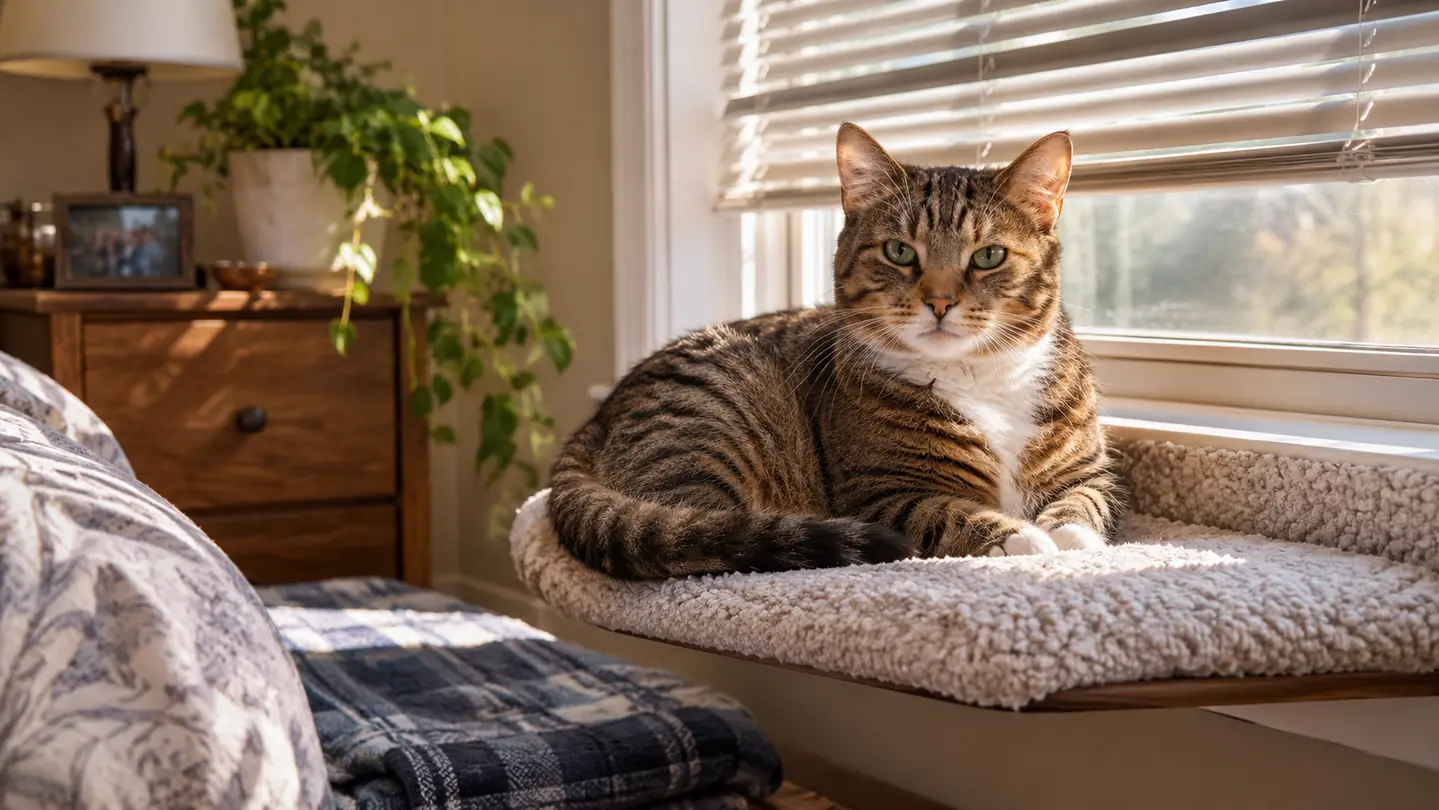
Biscuit stopped jumping onto the bedroom windowsill sometime last spring. I did not notice it happening. I noticed it the way you notice most things with a 14-year-old orange tabby: one day the perch was empty, and the next thing I knew he was taking the stairs one at a time, front paws down, then back paws, like a man on a ladder he does not trust. Our vet found mild arthritis in his hips and back legs. She did not hand me a cure. She handed me a plan, and fish oil was one line on it. The liquid that ended up in my fridge door was Nordic Naturals Omega-3 for Cats. I spent 22 years as a veterinary technician before I retired, so I had squirted omega-3 into a lot of bowls. I still got it wrong the first month with Biscuit. Here is the version that finally worked.
Adding oil to a cat's food sounds like the easiest job in the world. It is not, for three reasons. Cats are suspicious of anything that changes the smell of dinner. Oil poured over dry kibble mostly sits on the surface and ends up on the cat's chin. And the amount that lands in the cat is rarely the amount you measured, because some of it stays on the spoon. Nordic Naturals Omega-3 for Cats is the liquid I keep coming back to, largely because it is unflavored and made from the same oil the company sells for people. The label lists EPA and DHA, the bottle is 60 ml, and the oil comes from wild-caught fish in batches tested for purity. But the bottle is the small part of this. The method is the rest.
The Bottle That Lives in My Fridge Door, Not in the Cabinet
Nordic Naturals Omega-3 for Cats is an unflavored 60 ml liquid with EPA and DHA in triglyceride form, made from wild-caught fish and batch tested for purity. A cat-sized amount is tiny, which is exactly why the bottle stays small.
Amazon Check Today's Price on Amazon →Step 1: Get a Number From Your Vet Before You Open the Bottle
This is not the step anyone wants. It is the step that makes the other four work. Our vet weighed Biscuit, looked at his bloodwork, and gave me a target in milligrams of combined EPA and DHA per day rather than a teaspoon. Vets talk in milligrams because a fish oil label lists EPA and DHA separately, and the total is the number that matters. A target also accounts for the cat in front of them, which is something the average cat on the internet cannot do.
Ask three things while you are there: how much, how often, and what would make you stop. If your cat takes any medication, ask about interactions before the first drop. Fish oil is generally well tolerated, but it is not nothing. At higher amounts it can loosen stools, and it adds calories, which matters for a cat already carrying extra weight on sore hips. While you have the vet's attention, ask what else belongs on the plan. In our case that was weight, a ramp to the windowsill, and a recheck in three months. The oil went on the list as support, not as the whole list.
Step 2: Pick a Liquid Your Cat Will Actually Take
Unflavored is the word to look for. Plenty of pet omega-3 is flavored for dogs, and a cat noses that immediately. Nordic Naturals Omega-3 for Cats is unflavored, which is the reason it survives being folded into a spoonful of pate. The label reads liquid, 60 ml, with EPA and DHA in triglyceride form, the form those fatty acids take in actual fish.
Purity is the other thing. Fish oil is a fat, and fat goes rancid. Nordic Naturals states that each batch is made from wild-caught fish and tested for purity, and while no label is a guarantee, batch testing is the part of a label worth caring about when a cat will be taking this for months. Open the bottle when it arrives and smell it. Fresh fish oil smells mild. Rancid oil smells like old paint, and the cat will refuse it before you do.
Two ounces looks small on a counter. It is not small for a cat. Sixty milliliters at a cat-sized amount is a real supply, and a bottle about four and a third inches tall fits in the fridge door where you will actually see it. Write the open date on the cap with a marker. Keep it upright, because a tipped bottle leaks oil down the shelf and you will smell it for a week afterward. A small bottle you finish beats a large one that oxidizes at the back of a cabinet.
Step 3: Start at a Quarter Amount and Build Over Two Weeks
The first week is a test, not a treatment. I start every cat, Biscuit included, at about a quarter of the target and hold it there for four or five days. Not because the oil is dangerous. Because a cat's gut notices a sudden new fat, and loose stool on day three is the most common reason people quit before anything has had a chance to work.
After four or five clean days, go to half. Then three quarters. Then the full amount your vet gave you. If stools loosen at any point, drop back to the last amount that was fine and hold there another week. Two weeks of building is normal, and nobody is grading you on speed.
Measure with something you can read. I use a small oral syringe from the pharmacy, the kind without a needle, and I pull the plunger to the mark our vet gave me. A kitchen teaspoon is a guess, and a guess is fine in a dog's bowl and not fine in an eleven pound cat's, because a quarter teaspoon of difference doubles or halves what he gets. Rinse the syringe under warm water after each use, stand it up in a cup to dry, and keep it in the same drawer as the bottle so the two never get separated.
Call the vet rather than adjusting on your own if you see vomiting, refusal to eat, or a cat who seems uncomfortable. Those are not typical reactions to fish oil, and they deserve a phone call instead of a guess.
The bottle was never the hard part. The hard part was measuring the same amount on a Tuesday that I measured on a Sunday, and writing down what changed.
Step 4: Mix It Into the Right Food at the Right Temperature
The first thing I tried was the obvious thing. I poured the oil over his dry kibble and set it down. He ate around it, and not delicately. He pushed the coated pieces to the edge of the bowl with his nose and left a ring of them. The second attempt was worse. I held him and squirted the oil into the side of his mouth the way we used to dose medicine at the clinic. It worked exactly once. After that he saw my hand coming and left the room, and I had traded a food problem for a trust problem. That is the mistake I would take back if I could.
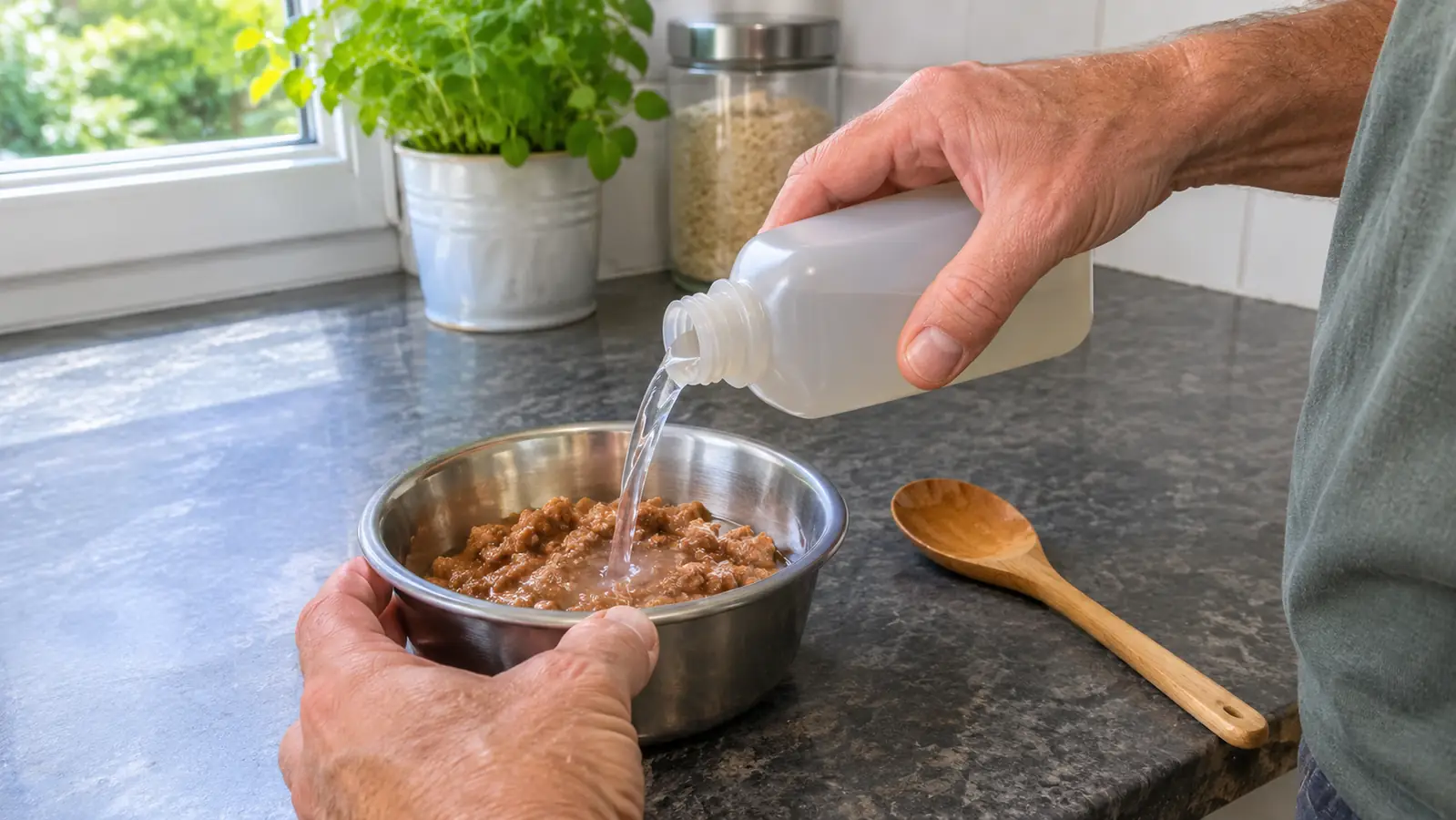
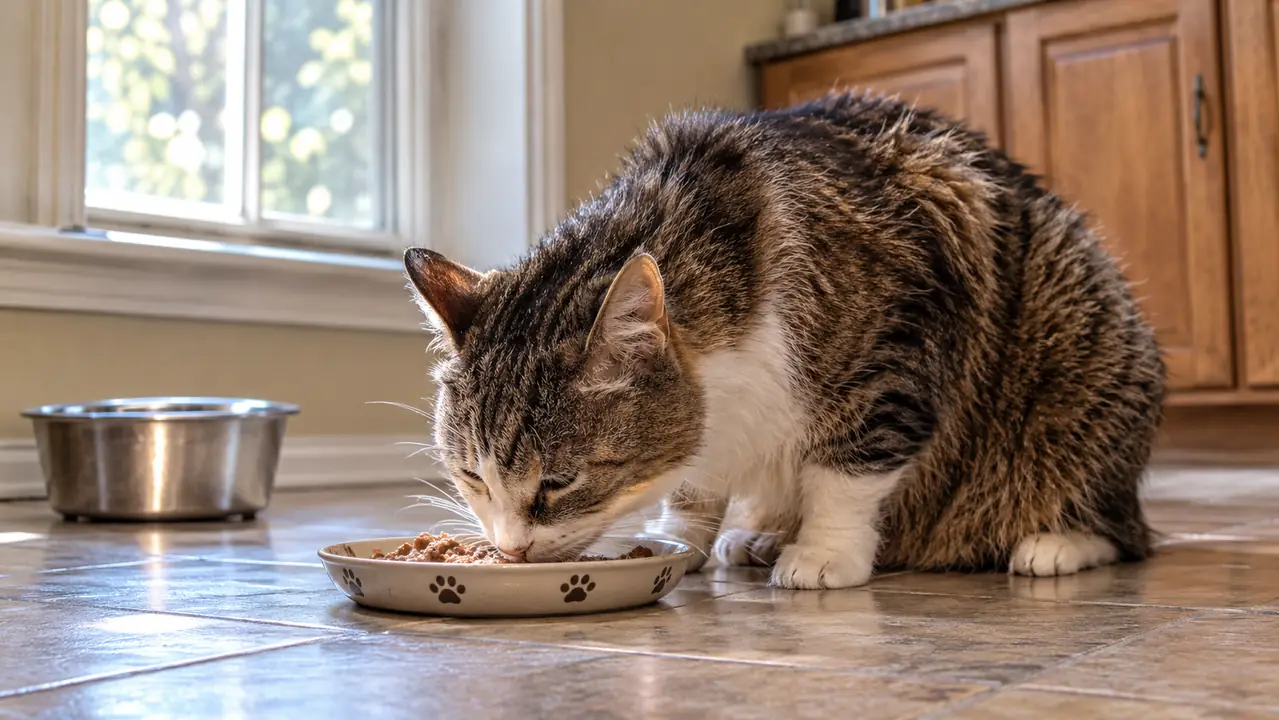
Wet food, room temperature, small amount first. I spoon about a third of Biscuit's portion into a small dish, add the oil, stir until it disappears, and set that down. When he has eaten most of it, the rest of the portion goes into the bowl. That does two things. It makes sure the amount is eaten rather than left in the corner of the dish, and it means a refusal costs a third of a can instead of the whole thing.
Do not heat the food to hide the oil. Heat is what turns a delicate fat rancid, and a microwave does it unevenly. If the food is coming out of the fridge, let it sit on the counter for ten minutes or run the can under warm tap water. Room temperature, not warm.
If your cat will not touch wet food at all, mix the amount into a teaspoon of something soft he already values, and count that teaspoon as the dose rather than as a meal. What you do not want is oil sitting on dry kibble, coating the outside of each piece and ending up on the cat's chin and the floor.
The first week of this, Biscuit walked away from the dish twice. I did not chase him and I did not add anything to tempt him back. I picked the dish up after ten minutes, put it back in the fridge, and offered the same portion at the next meal. He ate it. A cat who learns that walking away makes the food disappear tends to stop walking away. A cat who learns that walking away produces a fresher can of something else has just trained you.
Step 5: Write Down Five Things for Eight Weeks
Memory is bad at this. You will not remember in March whether he was taking the stairs better in January. So write down five things once a week, same day, and keep the list on the fridge. Which windowsill or chair he got onto. How he took the stairs. Whether he hesitated before jumping down. Whether he made it to the litter box cleanly. How his coat looks. Five lines, once a week.
Here is what a line actually looks like at our house, from a week in February. Tuesday: on the low perch by the window in the morning, first time in a while. Stairs down one at a time, no pause at the top. Jumped off the couch, landed a little stiff. Litter box clean. Coat smoother on his back. Five short lines took me about a minute to write. Eight weeks of those is a record you can hand to a vet, and it beats trying to remember how things were in January.
Do not judge it at day ten. Omega-3 fatty acids change cell membranes slowly, and the changes people describe, when they describe them, tend to show up somewhere between four and eight weeks. What you are looking for is a trend, which is exactly what five lines a week for two months gives you and what one good Tuesday does not.
And here is the part I would rather say out loud. It may not do much. Mild arthritis is progressive, and no oil reverses it. What you are buying is a reasonable chance at some joint comfort and a better coat, in a form a cat will actually eat. If eight weeks go by and the five lines look identical, that is real information, not a failure. Take the notes to the vet and change the plan.
What Else Helps
Fish oil is one line item. The rest of the plan usually matters more. Weight is the biggest lever with an arthritic cat, and a single extra pound on an 11 pound cat is a lot of load on sore hips. Our vet put Biscuit on a measured portion instead of a topped-off bowl, and that change did more visible good than anything that came out of a bottle.
Then the house. A low, stable perch by the window instead of a high one. A shallow litter box with a low entry, because a sore cat will hold it rather than climb into a deep box, and that is how you get accidents outside the box that look behavioral and are not. A warm place to sleep. A non-slip rug on the hallway tile if your cat is slipping on the turns.
And a recheck. Arthritis is diagnosed by a vet's hands and sometimes an x-ray, not by a supplement bottle. If your cat has stopped jumping, is stiff after naps, or is missing the litter box, that is a vet appointment first and a supplement conversation second. Nordic Naturals is what sits in my fridge door, but it comes after the exam, not instead of it.
Unflavored, Sixty Milliliters, and Small Enough to Finish Before It Turns
A cat's daily amount is tiny, which makes a 2 oz bottle a real supply rather than a starter size. Liquid with EPA and DHA in triglyceride form, from wild-caught fish, batch tested for purity. Get the number from your vet first, then order.
Amazon Check Today's Price on Amazon →