
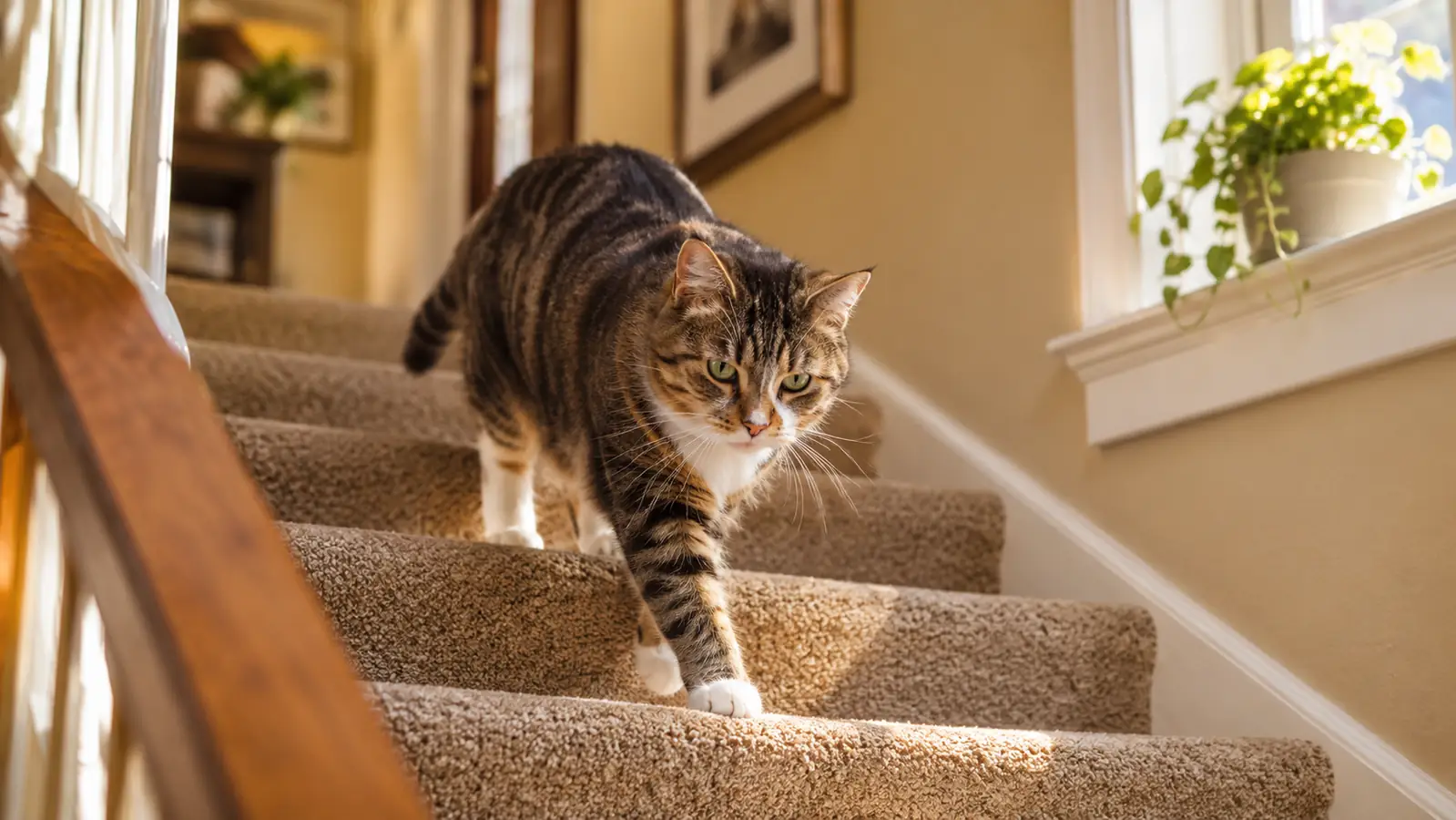
Biscuit stopped jumping onto the bedroom windowsill about a year ago. I did not think much of it at first. He was fourteen, an orange tabby with a good appetite and strong opinions about breakfast, and I assumed he had decided the bed was simply more comfortable. Then I watched him take the lanai stairs one step at a time, both back legs landing together, and I recognized the look. I spent twenty-two years as a veterinary technician. I have seen that hesitation in a hundred cats, and it usually means arthritis.
Here is what I tell people who ask me about joint supplements for cats. A supplement is not a treatment. It will not rebuild a worn hip, and it will not turn a fourteen-year-old cat back into a kitten. What a product like Cosequin from Nutramax can do, in some cats, is support joint comfort and normal movement while you handle the parts that matter more. The catch is that the supplement only helps when the routine around it holds up. A cat who licks the powder off the food and walks away has been dosed zero times, no matter what the label says.
So this is the routine I would set up for my own cat, and it is close to the one I walked a lot of clients through at the clinic. Five steps, in this order. Nothing on the list is complicated, which is exactly why people skip it.
The Capsule Is the Easy Part. The Routine Is the Work.
Cosequin for cats is an 80-count sprinkle capsule with 125 mg of glucosamine hydrochloride and 100 mg of sodium chondroitin sulfate in each capsule. The powder goes on the food. Everything else in this article is about making that happen seven days a week.
Amazon Check Today's Price on Amazon →The Five-Step Routine
Step 1: Get the Diagnosis Before You Buy Anything
Slow is not a diagnosis. The first step is having your vet put hands on the cat. Arthritis in cats is typically found by feel and by watching the cat move, sometimes with x-rays, but plenty of other things make a cat move differently. Dental pain, kidney trouble, thyroid disease, and plain muscle loss all look like a cat who has stopped jumping. If you start supplementing a cat with a sore mouth, you will spend six weeks wondering why nothing changed.
What I ask at that appointment: is this arthritis, and is a glucosamine and chondroitin product safe for this particular cat? Your vet has the bloodwork and the history in front of them. I am not going to pretend a web page knows your cat better than that. In our house, our vet found mild arthritis in Biscuit's hips and back legs. It was the answer I expected, and I still wanted it confirmed before I bought anything.
That visit also gives you a baseline, and the baseline is the part people forget. Write down what the cat will not do today. For us it was the windowsill and the lanai stairs. Without that note, six weeks from now you will not be able to tell whether anything improved or whether you have just gotten used to it.
I want to be honest about what I did before that appointment, because it is the pattern I see most often. I bought a soft joint chew from the pet store on a Saturday, because the label promised hip and joint support and the clerk said everyone bought it. Biscuit ate two and then turned his nose up at the rest. I spent five weeks telling myself he was getting something when he was getting nothing, and the rest of the chews went stale in the cupboard. A product bought on hope, a cat with opinions, and no plan for what happens on day four. The vet visit is what broke that loop for us, and it is why this step comes first.
Step 2: Let Your Vet Set the Dose
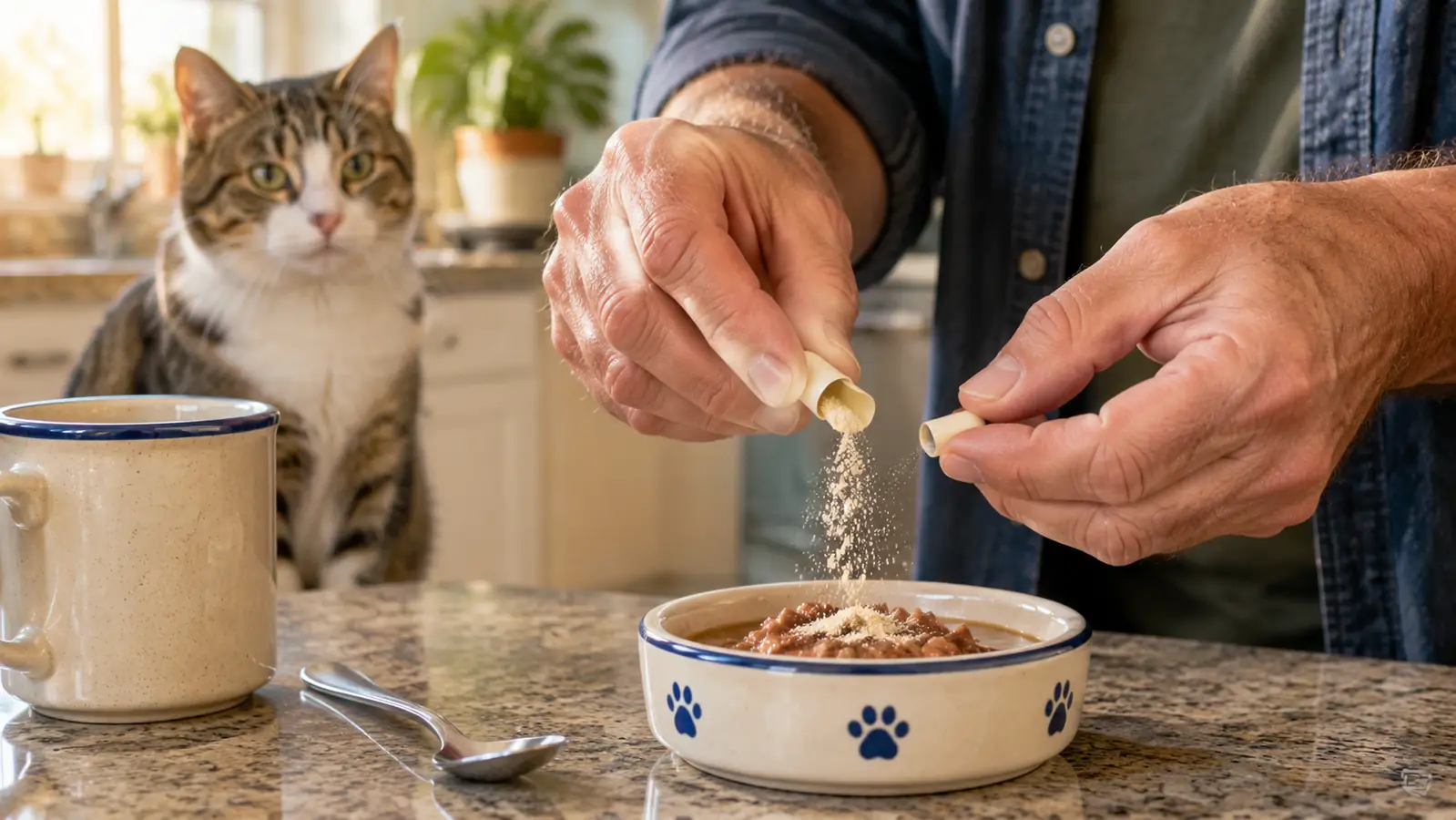
Cosequin for cats is a sprinkle capsule, which means the delivery method is simple: you open the capsule and mix the powder into food. Each capsule carries 125 mg of glucosamine hydrochloride, 100 mg of sodium chondroitin sulfate, and manganese. The powder is chicken flavored. There is no pill to hide in a treat and no chew to get refused, though that does not mean every cat will cooperate on the first try. Nutramax has been in pet health for over 25 years, and the label carries the claim that Cosequin is the top veterinarian recommended retail joint health supplement brand.
Ask your vet how many capsules per day for your cat, and whether to start at that amount or build up to it. Do not lift a dose from a forum thread or from the label of a different product. Package directions are written for a general case. Your cat is not a general case, especially if there is kidney disease, diabetes, or another prescription already in the picture.
One more thing about the chicken flavoring. It helps with acceptance, and it matters if your cat has a food sensitivity your vet is tracking. Say the words out loud at the appointment: chicken flavored, glucosamine, chondroitin, manganese. Ten seconds of questions beats a month of guessing, and it costs you nothing but the asking.
Step 3: Pair the Powder With Food Your Cat Actually Finishes
The powder needs a carrier. I use a spoonful of wet food, just enough that the cat will finish it in one sitting, and I put that down before the rest of the meal so I know it went in. Sprinkling over a big bowl of kibble that sits out all day is how doses get half eaten and quietly abandoned. You will find the crusted powder at the bottom of the bowl three hours later and realize you have been guessing for a week.
If your cat is a slow or suspicious eater, split the day's capsules between two meals, assuming your vet agrees with that approach. Two small portions are easier to finish than one large one, and a cat who cleans the dish is a cat who got the whole dose. Keep the mixed portion cool until it goes down. If the cat walks away, do not leave the doctored food standing there to dry out. Try again at the next meal with less food and more patience.
Portion size matters more than the dish, though the dish matters too. I use the same small ceramic saucer every day so Biscuit learned that saucer means the good stuff. I measure the wet food with a tablespoon instead of eyeballing it, because a portion that is too big leaves powder behind and a portion that is too small lets the capsule smell overwhelm the food. Three tablespoons of pate is about right for an eleven pound cat in our house. If your cat eats shreds in gravy, the powder sinks and stays mixed, which is easier. If your cat eats dry food only, ask your vet about moistening the powder with a little water first, because a dry eater will often work around the damp patch and leave most of the dose sitting in the bowl.
Step 4: Anchor the Dose to Something You Already Do
A supplement given four days out of seven is a supplement you cannot judge. The fix is to attach the dose to something that already happens every day without fail. In our house it is the first coffee. The bottle lives beside the coffee maker, and I do not sit down with the mug until the capsule is in the food and Biscuit is eating.
Pick a marker you can see. A tally on the wall calendar, a note in the phone, or a weekly pill organizer with seven compartments and one capsule in each. That last one is the most reliable system I know. At the end of the week the empty compartments tell you the truth, including the days you were certain you had dosed the cat and had not. Everybody has those days. The organizer does not care about your certainty.
One warning about the anchor. I moved the bottle from Nutramax three times in the first month, and every move cost me a day. The cabinet above the sink was tidy and completely useless, because I do the capsules at the coffee maker, not at the sink. The pantry shelf was worse, since it is where the cat food lives and I was in and out of it all day and stopped noticing the bottle at all. Wherever you land, leave it there. Cats are creatures of habit and so are the people who live with them, and a bottle that keeps moving is a bottle that gets forgotten.
Step 5: Measure What Changed, Not What You Hoped For
Glucosamine is not a painkiller. It does not work like one and it does not feel like one, so do not expect the response you would get from a prescription analgesic. What owners usually describe, when they describe anything, is a cat who seems more willing. More willing to take the stairs, to get up on the low perch, to stretch out instead of sitting bunched up. That willingness is the signal to look for.
Keep a two line log. Date on one line, one specific observation on the other: used the windowsill, took the stairs without pausing, jumped onto the bed. Specific beats general every time. A note that says he seems better tells you nothing in six weeks. A note that says he took all four lanai stairs without stopping tells you something you can bring to the vet.
Give it four to eight weeks before you form an opinion, then check in with your vet at the end of that stretch. Some cats show a difference. Some show nothing at all, and that is a real answer too. If your cat is visibly painful, a joint supplement is not the plan. That conversation belongs to your vet, and it may involve prescription pain control, laser therapy, joint injections, or a weight program that does more than any capsule ever will.
There is also a middle outcome nobody warns you about, and it confused me for most of last winter. The cat improves a little, you relax, and then a cold damp week arrives and he is stiff again on the stairs. That is not the supplement failing. Arthritis is not a straight line, and a raw stretch in February will set back a cat who was doing well in October. What you are reading in the log is the trend across a month, not the day to day. If Biscuit skipped the stairs on a Tuesday and used them every other day that week, the trend is still good, and one bad day is not a reason to stop.
Two weeks in, the change was not that Biscuit jumped higher. It was that he stopped pausing at the bottom of the stairs before he started up.
What Else Helps
Weight is the biggest lever, and nobody likes hearing it. A cat carrying extra pounds is loading arthritic hips with every step. Our vet set a target weight for Biscuit, and we cut back the treats before we changed anything else in the house. If your cat is overweight, that single change may do more for mobility than the supplement does.
Then look at the house through the cat's eyes. A litter box with a low entry saves a squat that hurts. A rug at the bottom of the stairs stops the skid that makes cats quit using the stairs altogether. A step or a ramp up to the favorite windowsill gives the cat a way to keep the habit instead of grieving it. Warm bedding in a draft free corner matters more than people expect, especially on cold tile floors.
While you are at it, keep the nails trimmed and the coat brushed. A cat whose front claws have grown into a curve has less grip on the floor, and poor grip makes a stiff cat stop trying to move at all. Biscuit gets his front nails done every three weeks, two claws at a time while he is sleepy, which is all he will tolerate and all he needs. Brushing matters for the same reason. An arthritic cat cannot reach his lower back the way he used to, and mats there pull on sore hips every time he shifts position. Five minutes with a soft brush a few times a week keeps that from becoming its own problem.
For a deeper look at the product itself over six months of daily use, the long-term Cosequin for cats review covers it in detail. If you are deciding between the capsule and a liquid, the comparison of Cosequin for cats versus liquid glucosamine walks through that choice. There is also a short list of reasons glucosamine helps senior cats if you want the plain version to share with a family member. All of that is about the product. This page is about the routine, and the routine is the part you actually control.
Start With the Vet. Then Start the Capsules.
Cosequin from Nutramax is an 80-count sprinkle capsule with chicken flavored powder that goes straight onto the food. One bottle, one daily habit, and a written log to tell you honestly whether it is working.
Amazon Check Today's Price on Amazon →