
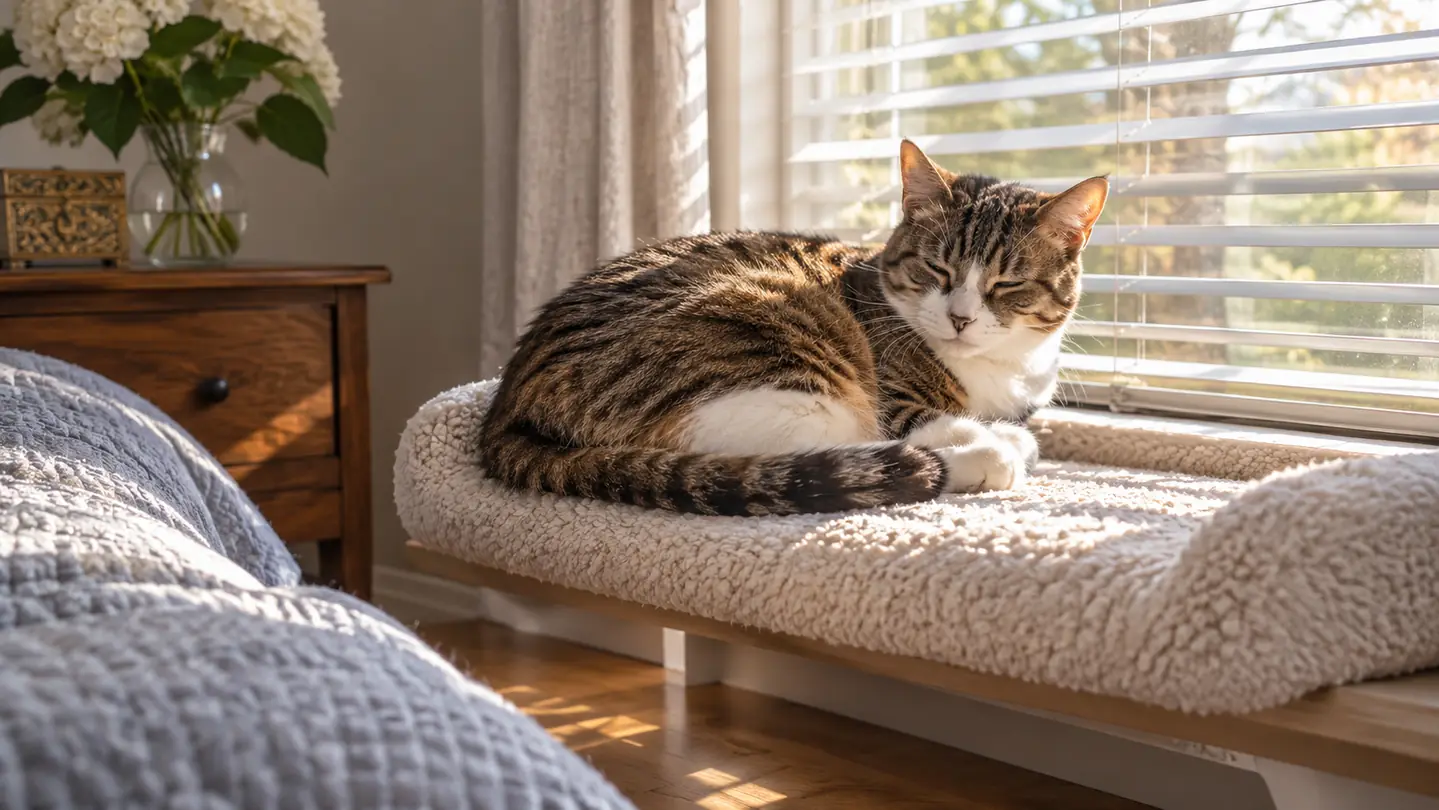
Biscuit stopped jumping onto the bedroom windowsill last spring, and I did not notice for about three weeks. That is the part I am not proud of. He is a 14-year-old orange tabby, roughly 11 pounds, and he had always treated that windowsill like his personal office. When our vet took x-rays, she used the word mild in front of arthritis, as though the adjective made the sentence easier to hear. Then he started taking the stairs one at a time, front paws together, then back paws, pausing on the third step every single trip.
I spent 22 years as a veterinary technician in a small-animal clinic before I retired to Sarasota, so I knew what I was looking at. I also knew that no chew, powder, or capsule reverses arthritis in a cat. Pet Honesty Senior Cat Joint Chews was the first thing I tried anyway, mostly because the flavor claim was loud and the active ingredient list was short enough to read in one pass. This is what six weeks of it looked like, including the parts the product page does not lead with.
The Quick Verdict
A short, readable active ingredient panel and a chicken chew most cats will actually eat. It will not fix arthritis, and the shellfish source rules some cats out.
Amazon Check Today's Price →The Chew Biscuit Actually Ate, Six Weeks Running
Chicken flavor, 300 crunchy bites per pouch, and four named actives on the panel. Read the label and check today's price for yourself.
Amazon Check Today's Price on Amazon →How I've Used It With Biscuit
The pouch is small. The listing puts it at 7.05 by 4.37 by 1.18 inches and 3.88 ounces, which is about the size of a paperback and roughly as heavy as a deck of cards, and it holds 300 of the crunchy bites. I keep it in the cabinet above the treats so Biscuit does not learn to sit by it and yell. I started him at the low end of the feeding directions printed on the bag and confirmed that amount with our vet before the first one went into his bowl, which is the only responsible way to start any supplement with a cat who is already on other medication. I also wrote the start date across the front of the pouch in marker, April 12, because I have learned the hard way that six weeks from now I will not remember whether we began in April or in May.
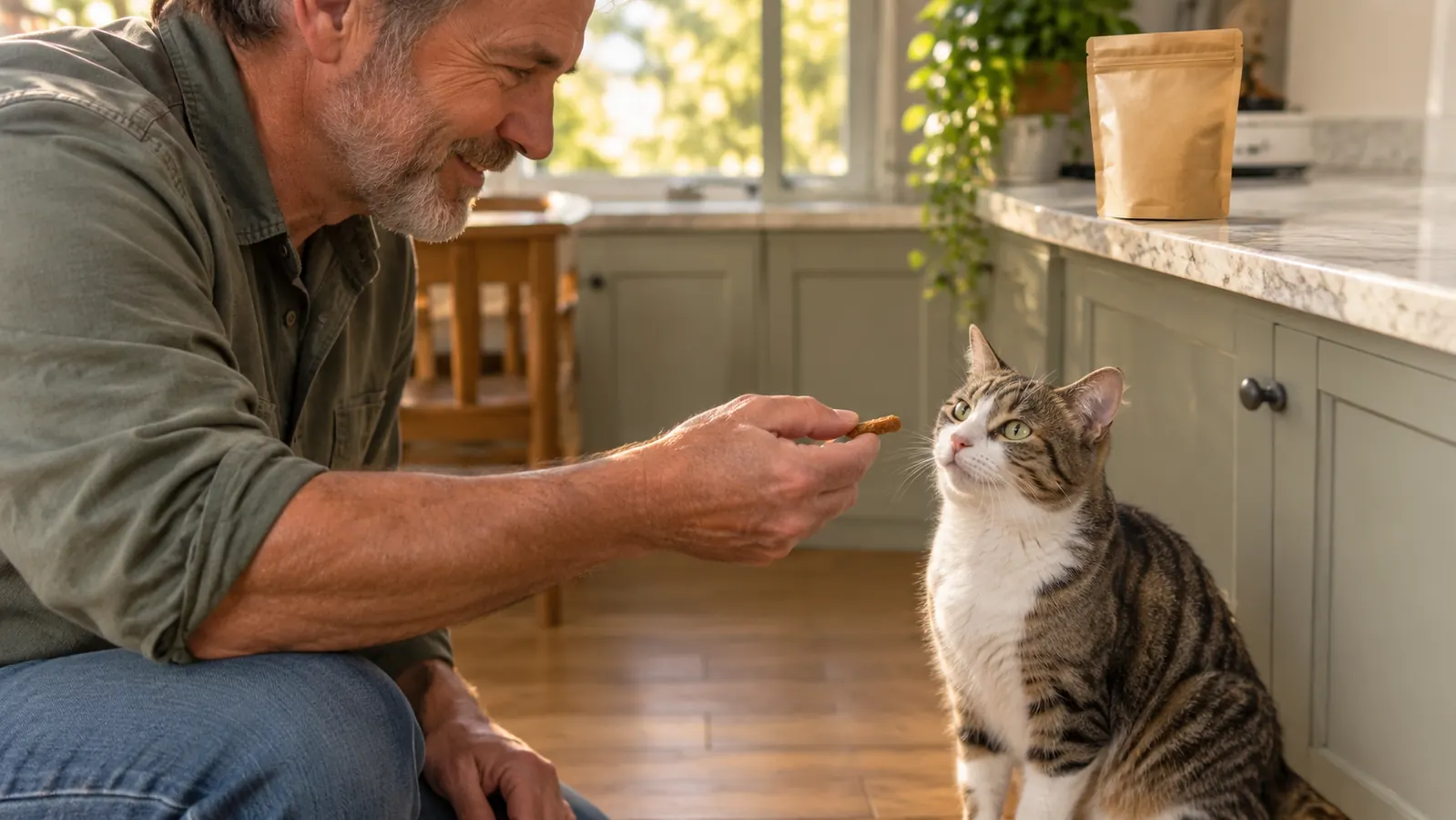
Here is the practical thing nobody mentions. Biscuit is a cat, and cats are suspicious of anything new in their bowl. I crumbled the first few chews over his regular food rather than offering them whole, and I did that for four days before I tried holding one out to him. He took it from my fingers on the fifth day. The listing claims nine out of ten cats like the flavor, and I cannot verify that number, but I can tell you the chicken smell is strong enough that my husband Ray asked what I was cooking.
Six weeks is not a clinical trial. It is one cat, one household, and a woman who wanted her friend to feel better. I say that up front because the internet is full of people who gave a chew for ten days and then wrote a review as if they had run a double-blind study. I weighed Biscuit at the start and at the end. I kept the same food, the same litter, the same stairs, and the same vet appointments. The only thing that changed was the chew. I also taped a sheet to the refrigerator door with a column for each week and three things I filled in every Sunday night: how he took the stairs, whether he used the windowsill perch, and how long he stayed down after a nap before he got up. It was not science. It was a way to stop myself from remembering whatever I wanted to remember, which is what happens when you have paid for something and need it to have worked.
What Nobody Tells You About Cat Joint Chews
The first thing is that these products are not painkillers. They are not anti-inflammatories the way a prescription is. Glucosamine, green lipped mussel, and the mineral ingredients in this pouch are there to support the cartilage and the joint environment, and the honest word for that is support. If your cat is in obvious pain, if he cries when you pick him up, if he is hiding or not eating, that is a vet visit and not a shopping decision. I have watched too many owners spend months on chews while an untreated problem got worse.
The second thing is that improvement, when it comes, is slow and boring. You are not going to see a cat leap onto a counter on day three. What you might see, around week three or four, is a cat who stops hesitating at the bottom of the stairs, or who gets down from the couch in one motion instead of two. That is what it looks like in real life. It is easy to miss if you are watching for something dramatic.
The third thing is that a chew only works if it goes into the cat. This sounds obvious and it is the number one reason these products fail in a household. A cat who eats around the chew, or who eats it once and then refuses it, gets nothing. That is why I started by crumbling it. It is also why a soft chew, a capsule you can open, and a powder you can mix are all reasonable formats, and why one of them will suit your cat better than the others for reasons that have nothing to do with the ingredients.
What Is Actually in the Bag
The active ingredients panel on the Pet Honesty pouch lists four things: glucosamine HCL from a shellfish source, green lipped mussel, calcium fructoborate, and manganese sulfate. That is a sensible, boring, defensible lineup. Glucosamine and green lipped mussel are two of the most common joint ingredients in veterinary supplements for a reason, and I have seen both used in a clinic setting for years. Calcium fructoborate and manganese sulfate are the supporting cast, trace minerals that appear in joint formulas because they are involved in the same pathways, not because they do anything dramatic on their own. I read the whole panel with a magnifier the first time, because the print on a pouch four inches wide is not designed for a 63-year-old's eyes, and what I found was a short list with nothing buried in it.
The listing bullets also mention chondroitin and omega 3 fatty acids. Those are real joint ingredients and they show up in the marketing copy, but the active ingredients panel I can read is the four-item list above. I am not calling that a bait and switch. Formulas get reformulated, panels get compressed onto small packaging, and listing copy is often written months ahead of a label change. I am telling you to turn the pouch over and read the panel on the bag that arrives at your door, and to email the company directly if chondroitin matters to you. It is a five-minute question with a written answer.
The label also says non-GMO and lists benefits beyond joints: antioxidant, digestive health, heart health, immune support. Some of that is the green lipped mussel doing double duty, and some of it is a supplement company filling out every field the form asks for. I care about the joint line. The rest I treat as a bonus.
Six Weeks In: What Changed and What Didn't
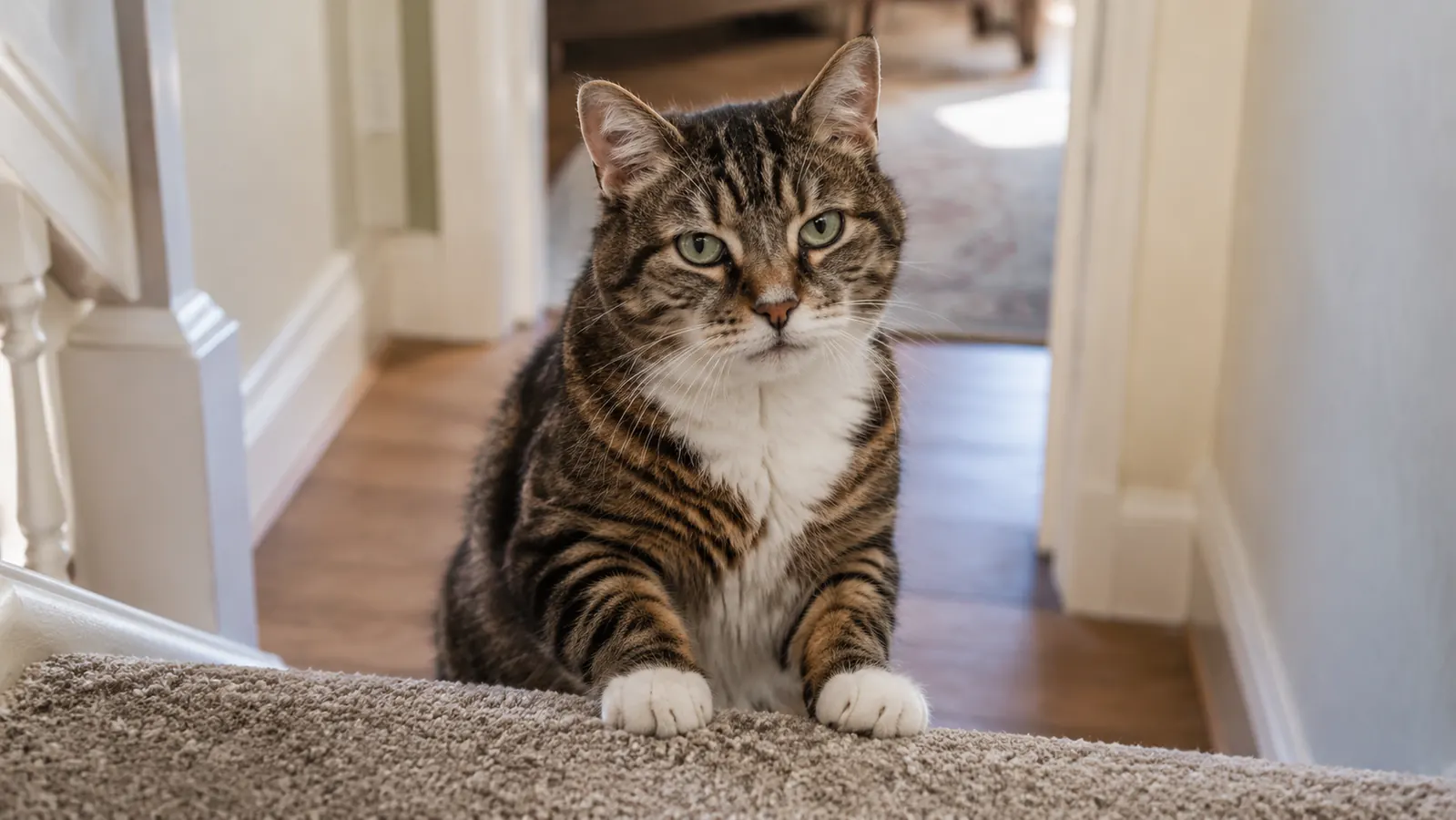
By week three, the pause on the third stair was shorter. That is the entire claim I will make. Not gone. Shorter. The night I actually wrote it down was a Tuesday in the fifth week, around 8:40, when Biscuit came down the hall from the bedroom, hit the staircase, and went up all nine steps without stopping. I counted from the kitchen doorway with a dish towel still in my hand. Nine steps, no pause, and then he sat at the top and looked down at me like I had asked him a question. Twice that same week I watched him get onto the low windowsill perch in the bedroom, the one I had honestly assumed he was finished with. He did not leap. He put his front paws up, pulled, and settled in. It took him longer than it used to, and he sat there looking extremely pleased with himself.
What did not change: he still groans when he stands up after a long nap. He still prefers the floor to the couch on cold mornings. He still has arthritis, and the x-rays from this spring still say what they said. The chew did not undo anything. It may have bought him a little comfort and a little range of motion, and that is worth something to me when the cat in question has slept on my pillow for fourteen years.
By week three, the pause on the third stair was shorter. That is the entire claim I will make. Not gone. Shorter.
The Parts I Do Not Love
The shellfish source is my biggest caution. The glucosamine HCL here comes from shellfish, and green lipped mussel is a shellfish. If your cat has ever reacted badly to shellfish, or if you simply do not know, call your vet before you open the bag. That is not a small footnote. It is the first thing I would ask about any glucosamine product, and I have asked it about this one.
Second, the flavor is strong. That is exactly why Biscuit eats it, and it is also why the pouch smells like a chicken bouillon cube the moment you open it. I keep mine doubled inside a zip bag. Third, 300 chews sounds like a fortune and it is a generous count, but the pouch itself is small, so I moved mine into a jar after the first week mostly to keep the smell contained.
What I Liked
- Short, readable active panel: glucosamine HCL from shellfish, green lipped mussel, calcium fructoborate, manganese sulfate
- Chicken flavor strong enough that a picky 14-year-old cat took it from my fingers by day five
- 300 crunchy bites per pouch, so one bag covers a long stretch
- Made for cats specifically, and labeled non-GMO
Where It Falls Short
- Shellfish-derived glucosamine and green lipped mussel make it a no for cats with shellfish sensitivity
- Listing bullets name chondroitin and omega 3s that are not on the active panel I read
- Strong smell once the pouch is open
- It is support, not pain relief, and it will not reverse existing arthritis
I want to be clear about what four stars means here. It does not mean this pouch is the best joint product ever made. It means Pet Honesty did what a support product is supposed to do for one cat in one house, the ingredient panel is one I can defend, and the drawbacks are real and disclosed. That is a good product with honest limits.
How It Stacks Up Against the Other Things I Tried
Before this I tried a sprinkle capsule, the kind you twist open over the food. The ingredient list was fine. The problem was that Biscuit is a grazer, and he would eat the food around the powder and leave a little ring of it in the bowl, stuck to the ceramic like sand. I tried mixing it into a spoonful of wet food and he licked the wet food clean and left the powder behind, which I did not know a cat could do until I watched him do it. I tried a soft chew from another brand and he chewed it once and walked away from it with real contempt. The format is the variable nobody talks about. A crunchy chicken bite is the only thing in this house that has made it into the cat rather than into the trash.
If your cat already eats a powder without complaint, you do not need to switch. If your cat is a grazer, or if you have already thrown away half a tub of powder, a chew is worth trying. The tradeoff is that chews come with flavoring and a smell, and powders let you control the amount more precisely. Neither is better in the abstract. One is better for your cat.
What I Would Ask Your Vet First
Three questions, and the answers change what you buy. First: is there anything else going on? Arthritis in a 14-year-old cat often travels with kidney values that need watching, and a joint supplement is not a substitute for bloodwork. Second: does the shellfish source matter for this cat, given his history? Third: how much of this should he get, given his weight and whatever else he is taking? Our vet has been patient with me about all three.
The point is not to be paranoid. The point is that a supplement is one small piece of a plan that also includes weight management, soft bedding, a litter box with low sides, and a step stool if the stairs get harder. Biscuit has a low-sided box now and he uses it without complaint. That change did as much for him as anything in a pouch.
Who This Is For
This is for the owner of a senior cat who has slowed down in ways that are visible but not alarming. The cat who still eats, still uses the litter box, still comes when you shake the treat bag, but who takes the stairs one at a time now. It is for someone who has already had the arthritis conversation with a vet and wants to add a supportive piece to the plan. It is also for the owner who has tried a powder and watched the cat eat around it. Pet Honesty got the format right for that specific problem, which is more than I can say for most of what I have bought over the years.
Who Should Skip It
Skip it if your cat has a shellfish allergy or you do not know whether one exists. Skip it if your cat has not been examined yet and you are hoping a chew will tell you something, because it will not, and a vet can. Skip it if your cat is in visible pain, limping badly, or has stopped eating, because that is a different problem than the one this pouch addresses. And skip it if you are looking for something that replaces a prescription. Nothing on a shelf does that, no matter what the bag says.
If Your Cat Already Eats Around the Powder, Try the Chew Instead
Chicken flavor, 300 crunchy bites, four named actives. Read the panel, ask your vet about the shellfish source, then decide.
Amazon Check Today's Price on Amazon →